
10 Best Martial Arts Revenge Movies, Ranked
While not every martial arts movie is about revenge, a good many of them are, which is okay, because revenge works as something to drive the sort of conflict you want to see play out in such an action movie. Martial arts films foreground hand-to-hand combat, be it with or without weapons used at a close range, and that’s probably why revenge works well with such films. Seeing a character get direct and physical revenge with an intimate fighting style tends to be both more intense and ultimately satisfying, both for the person seeking vengeance and the viewer.
There are some action movies that feature revenge while almost feeling like martial arts movies (see The Crow and Oldboy), but it feels like a little bit of a stretch to call them genuine martial arts films. They’re great action movies about revenge with some hand-to-hand fighting, though, and were worthy of honorable mentions here, just without appearing in the ranking below, since this ranking’s focused on genuinely great martial arts revenge movies that are sufficiently martial arts-focused.
10
‘The Avenging Eagle’ (1978)

Though The Avenging Eagle doesn’t often get the appreciation it deserves, if you’re talking about all-time classic martial arts movies, it really should. There’s nothing here it really does wrong, in terms of delivering a good deal of exciting action within a no-nonsense narrative, here mostly just “complicated” by the fact that there’s one person who wants revenge against a particular clan for personal reasons, and another person who wants to fight back against that clan as a former member.
Both have been wronged by the same people, essentially, and so they form a duo to go about fighting a bunch of bad guys. The Avenging Eagle clocks in at just 90 minutes, and has a generous amount of well-choreographed fight scenes for a film of such a brief length (it also helps that there are quite a few different weapons used throughout, which keeps the action scenes sufficiently varied).
9
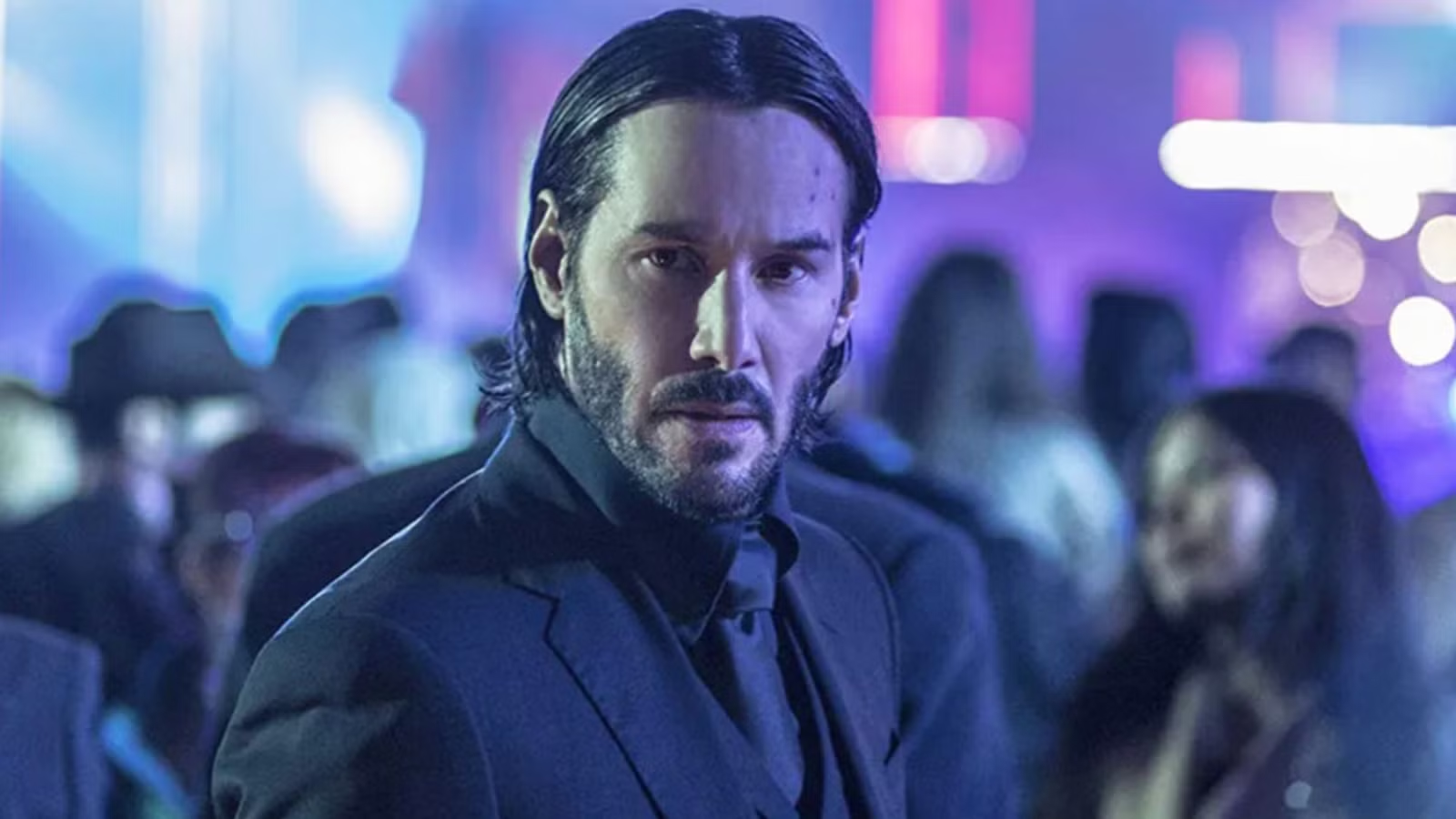
‘John Wick’ (2014)

While the sequels to John Wick get a bit wilder and perhaps even convoluted (not necessarily in a terrible way, since all the criminal underworld stuff proves quite entertaining), the first one is stunningly simple. The titular character is a man who’s lost pretty much everything by the time of the film’s start, except a puppy he was gifted by his wife before she passed away.
Some rather foolish criminals kill that dog and steal John’s car, so he sets off getting violent vengeance for them taking what little he had left, and since he’s got nothing left to lose, he doesn’t mind using the skills he used to have in his previous life as a hitman to get that revenge. Also, John Wick does admittedly have more by way of shootouts than all the other martial arts movies mentioned here, yet many of the fights here are kind of “gun fu,” combining some aspects of hand-to-hand combat with firearms, and that approach is one of the things that helps much of the action stand out.
8
‘Vengeance!’ (1970)

The exclamation mark in the title Vengeance! is well-earned, since this whole movie goes pretty big, loud, broad, and bloody. And not just bloody by the standards of the early 1970s, since this one still feels visceral today. It would’ve probably been a shock to the system back in 1970, though, doing for martial arts movies what The Wild Bunch kind of did for Westerns (and yes, that’s an entirely different movie, but it came to mind just now because that one was also graphic for its time, and still holds up as pretty darn violent to this day).
As for the plot of Vengeance!… well, it’s all in the title. There is a young man who’s murdered, and then his brother sets out to kill the people who killed him. And he goes very far in achieving such a goal, to the point where he begins to feel less and less heroic, more or less going from sympathetic, to an anti-hero, and then to someone similarly vicious as the violent people who got the whole blood-drenched mess started in the first place.
7
‘Lone Wolf and Cub: Sword of Vengeance’ (1972)

There’s a distinction between martial arts cinema and kung fu movies, because kung fu movies are a sub-genre of the martial arts genre (or a sub-sub genre to a sub-genre, if you want to count martial arts movies as an action sub-genre). So, there will be samurai movies worth mentioning here, even if they’ve obviously got a focus on combat with swords over literal hand-to-hand stuff, with the first of note, for present purposes, being Lone Wolf and Cub: Sword of Vengeance.
You’ve got “Sword” in the title, obviously, and it’s also near the word “Vengeance,” so go figure. This is the first of the Lone Wolf and Cub movies, which are, broadly, all about an ex-executioner being betrayed by the clan he once worked for, and seeking revenge against anyone who still belongs to said clan. He and his son get up to some other things throughout the series, and the six main films are all pretty great, but the first one’s being singled out here just because that sets up why the central character wants to become the vengeful one-man army he is for the rest of the series.
6
‘The 36th Chamber of Shaolin’ (1978)

The 36th Chamber of Shaolin is wonderfully straightforward, even by the standards of martial arts movies that involve revenge. Evaluated cynically, you could call it the most basic and no-nonsense of perhaps the quintessential martial arts movie premise (in that there’s a person who’s wronged, then that person trains, then finally, that person gets revenge), but less cynically, you could also say it’s the movie that does that straightforward premise the most seamlessly.
There’s catharsis here, and maybe that’s the main thing. The 36th Chamber of Shaolin spends what feels like the bulk of its runtime on the training, and that extended process proves surprisingly compelling to watch, as there are so many challenges – both physical and mental – for the protagonist to overcome. So, once he does master everything, he blasts through those who wronged him… and all that’s quite entertaining to watch, too.
5
‘Lady Snowblood’ (1973)

Another samurai movie, and one of the all-time great ones, Lady Snowblood is about a young woman who, from a young age, was basically brought up just to get revenge. It’s almost all she knows, given her mother lost almost everything, and then wished for her to be brought up as someone who could avenge all the deaths in the family that occurred before her birth.
In that sense, it’s quite a desolate and despairing movie, because the core story here is incredibly sad, even if there’s also some level of spectacle here (owing to the visuals), not to mention a good bit of excitement when there’s action (the fights here are rather bloody). Lady Snowblood does have a sequel, but it’s not the kind of thing where you really need to see that movie… not the case for a two-part film that Lady Snowblood famously inspired, but more on that duology in a bit.
4
‘The 8 Diagram Pole Fighter’ (1984)

Since both The 36th Chamber of Shaolin and The 8 Diagram Pole Fighter starred Gordon Liu, were directed by Lau Kar-Leung, and produced by Shaw Brothers Studio, they’d make for a pretty solid double feature. Also, they kind of have the same premise, but The 8 Diagram Pole Fighter ends up being a little more about the struggle to get revenge, as it sees its protagonist failing quite a bit more during his training.
The focus, as such, is a little shifted, and it also leads to the action in the final act being messier and arguably more thrilling. It’s an approach to that previously mentioned well-worn formula that ends up working quite well, and even if it’s a bit more chaotic overall (things had to be altered when one of the film’s stars, Alexander Fu, died suddenly during production), it’s still ultimately a great martial arts movie that’s (largely) about revenge.
3
‘Harakiri’ (1962)

Again, it’s a samurai movie, and one that doesn’t really emphasize action, for the most part, but Harakiri still feels very much worth mentioning because it’s eventually a pretty impactful revenge movie. Elaborating on the details or even mentioning revenge is a part of it could be ruining things, yet there’s also something to be said about the execution here, and that’s something you can only fully appreciate from watching the film.
Harakiri is largely a drama, and centers on a man who tells a samurai clan why he feels compelled to end his life via the titular ritual (sometimes called seppuku). The reason the movie’s light on action is that Harakiri wants to build tension and focus on a heavy-going narrative before, all so that you do feel the intensity of the fighting far stronger when it does eventually begin. The approach ends up working remarkably well, to say the least.
2
‘Kill Bill: Vol. 1’ (2003)
Kill Bill: Vol. 1 has more action than the second volume, yet that one’s heavily indebted to the martial arts genre in slightly different ways, even if it’s narratively a direct continuation. So, the first movie is getting mentioned first, and gets to take its own place here. It’s largely a homage to martial arts movies, with a particular focus on swordplay, and you get a ton of action in the final act.
This first volume of an overall epic moves at a wildly fast pace throughout, as in, if it were any faster, you’d probably feel overwhelmed and might struggle to keep up. The motivation of the main character, The Bride, is incredibly straightforward at this point in the story, and Kill Bill: Vol. 1, overall, is like, “Yeah, the nuance can wait; it comes later.” This one’s mostly about action, and the action is undeniably exciting.
1
‘Kill Bill: Vol. 2’ (2004)

So, if Vol. 1 has all the action, and Kill Bill: Vol. 2 is a technically talkier affair, why does it take the #1 spot over the first half of the story? It’s a fair question, and it’s first worth mentioning that there is still some action in Vol. 2, and what you do get is largely satisfying and well-choreographed. But there are more interesting places it goes as an exploration of revenge, and the dramatic highs and lows that come with actually getting vengeance.
Also, Kill Bill: Vol. 2 has a great training sequence that plays out as a flashback in Vol. 2, with the flashbacks also making The Bride (who’s even given a name in this half of the story) a more fleshed-out and compelling character. Bill’s also a proper character in this one, as opposed to the almost voice-only appearance he has in the first, and that helps, because he’s also a great character. Vol. 1 pays homage to martial arts action, while Vol. 2 pays homage to the comparatively “slower” scenes you get in most classic martial arts movies, and somehow, it all works, and adds up to an immensely satisfying whole.


