
10 Heaviest War Movies of All Time, Ranked
There are exceptions for sure, but most war movies should capture some kind of heaviness, or emotional intensity, since war itself is blatantly bad for reasons that hopefully don’t need to be explained too much. There are films like The Dirty Dozen and Inglourious Basterds that find ways to be exciting and thrilling, while still depicting real-life wars, but even those have their heavier moments.
All that’s to say that finding the heaviest war films is difficult, because most of them are pretty heavy, at the very least, by default. The following ones are particularly gruelling, by design, and while they’re all very much worth watching, you might only feel like sitting down and getting through them all at select times. There’s very little escapism or entertainment value (in the traditional sense) to be found in these.
10
‘Paths of Glory’ (1957)

There was a war movie Stanley Kubrick directed before Paths of Glory (Fear and Desire), but it wasn’t particularly great. Paths of Glory, on the other hand, was a phenomenal early effort for the filmmaker, and maybe his first all-out masterpiece, too. The narrative concerns the aftermath of a failed offensive, with three soldiers being put on trial as scapegoats for the whole ordeal.
It’s a war film at first, but then becomes more of a courtroom drama for the remainder of its runtime, though it’s quite riveting – and soul-crushing – on both fronts. The combat we do see is particularly visceral for a movie of its age, and then there’s a bleakness that comes with the idea that military court can be just as ruthless and uncaring about soldiers as all the stuff on the battlefield. Paths of Glory finds a relatively distinctive angle to hammer home the idea that war is hell, and it hasn’t really lost much of its power in the nearly 70 years since it first came out.
9
‘Apocalypse Now’ (1979)
Apocalypse Now is close to the definitive movie about the Vietnam War, though its narrative is one that could’ve happened during any war, really, just with some scenery changed, and maybe some weapons/technology seen, too. It wants to unpack the madness found in any kind of war, and it reflects this by only really feeling like a Vietnam War movie early on, and then getting a bit more abstract and intense as it progresses.
There’s a man, and he’s told to assassinate another man, since that man has unravelled psychologically, and then during that mission, the first man himself unravels psychologically. And various other horrific things happen, with the whole thing being an intentionally confusing and very much not fun time. But Apocalypse Now is still absorbing, and there is a power to it all that comes from how nausea-inducing it is, and how possessed it all feels.
8
‘Fires on the Plain’ (1959)

Maybe a little more obscure than some of the other movies here, Fires on the Plain is still vital, as far as World War II movies go, especially when it comes to the topic of realistic and/or powerful ones. It’s about a soldier who’s dealing with tuberculosis during the final days of World War II, and what happens after his fellow soldiers basically abandon him, and he’s left to try and survive (or not) on his own.
There’s another Japanese movie (well, trilogy of movies, specifically) that came out around the same time, and spent some time of its epic length doing something similar to Fires on the Plain (and that movie will be elaborated on in a bit). Fires on the Plain is mostly about the psychological impact of war, and how the horrors of warfare can continue even after the war itself seems to be “winding down.” It might sound simple on paper, but the execution here makes it surprisingly devastating.
7
‘Das Boot’ (1981)

Most epic movies, war-related or otherwise, don’t simultaneously feel claustrophobic, so that makes Das Boot stand out right from the start. It’s a movie about a submarine crew during World War II, and the camera is in the submarine for most of the film, alongside the crew, so characters and viewers alike get very little by way of relief. “Intense,” as a word to describe the whole thing, undersells it.
In Das Boot, the camera is in the submarine for most of the film, alongside the crew, so characters and viewers alike get very little by way of relief.
There is more to Das Boot, and a lot of ground narratively and character-wise that’s covered, mostly thanks to the movie being long (or really long, depending on which cut you watch) and also exceptionally well-paced. No time is wasted, even when Das Boot aims to capture how tedious war can be in its quieter moments, and the sense of everything feeling very real and visceral contributes to it feeling like quite an emotionally taxing watch, too.

30 years on from Paths of Glory, Stanley Kubrick directed Full Metal Jacket, which is partly concerned with showing an unexpectedly horrifying part of warfare, a little like that 1957 film. Here, instead of military court, the lesser-seen part of war explored is boot camp, with the film’s first half laying out how dehumanizing and psychologically harrowing it is for all involved.
Then, the second part feels like a more down-to-earth and expectedly intense Vietnam War movie, to the extent that the two halves feel a bit mismatched at first. But both halves of Full Metal Jacket show how soul-crushing war is, just in two different areas, and then once it clicks, the whole thing does feel coherent, at least thematically/narratively, because emotionally, the film remains chaotic and challenging.
5
‘The Deer Hunter’ (1978)

Of all the Vietnam War movies to win Best Picture so far (okay, admittedly not a ton, but still), The Deer Hunter was the first, and maybe the most intense of the bunch, too. That’s actually saying quite a bit, when Platoon also won Best Picture and was about the Vietnam War, but mostly focused on the combat side of things. The Deer Hunter, on the other hand, is about the various stages of taking part in a war, contrasting the before and after while also spending some time on the “during” part.
There’s a sense of not being entirely sure where things are going early on, since The Deer Hunter really takes its time with all the pre-war stuff, but the patient pacing pays off in the end. The structure of the whole epic-length film is done to make the Vietnam War – especially the U.S. participation in it – look as despairing and distressing as possible; there really is this crushing feeling, by the end, that it was all for nothing, and you get that through seeing just a handful of people impacted by the conflict in question.
4
‘Johnny Got His Gun’ (1971)

Though it’s frequently surreal, Johnny Got His Gun is also about as realistic as World War I movies get, which might sound paradoxical, but it really does manage to be both. The film concerns the experiences of a wounded soldier in one of the worst positions imaginable, as he’s been left without basically anything, but still alive somehow, without sight, hearing, smell, or any of his limbs, having nothing left but his mind.
And so Johnny Got His Gun mostly plays out inside his mind, as he tries to make some sort of sense out of the past, his thoughts, his previously held beliefs, and various other things. It’s all unquestionably horrific, and the intensity of this one – despite it being an older film – really gives most emotionally brutal modern-day war movies a run for their money.
3
‘The Human Condition’ (1959-1961)

Each film that makes up The Human Condition trilogy is downbeat and long, but the whole thing kind of is kind of one epic, and taking it all as a single film just makes it all the more harrowing and (obviously) long. It’s about 10 hours all up, and it spends this time with one central character and his experience resisting taking part in World War II, being made to do so regardless, and then having to survive after the war itself ends.
Every step of the way, The Human Condition is miserable, but in a very purposeful manner. It’s a difficult trilogy to shake, once seen, and the whole thing is incredibly hard to recommend in the traditional sense, though the trilogy is vital nonetheless. It should be watched through once, but probably not again (unless you’re really up for going through, a second time, the immense number of things the entire trilogy is willing to throw at you).
2
‘Grave of the Fireflies’ (1988)

If you’ve somehow not heard of Grave of the Fireflies, and how famously bleak it is, then you might enter into it hoping that the fact it’s animated will make it all a bit less confronting than it would be if it were live-action. This is most certainly not the case, since once you adjust to the animation, or get used to it, what happens here feels like watching real life in the most upsetting of ways.
The story of Grave of the Fireflies focuses on a boy and his younger sister, both of them left to fend for themselves during the final stages of World War II after they lose their mother. It starts sad, feels sad throughout, and then ends sad. Grave of the Fireflies is just sad. It does have to be, to drive home a story about war affecting those who are entirely victimized by it, despite not being active participants, and then it’s heavy-going for other reasons, too. It’s a lot to handle, even with the runtime being relatively slim and the violence technically not being as graphic as most war movies (it’s more the emotional impact of the story that proves to be brutal here).
1
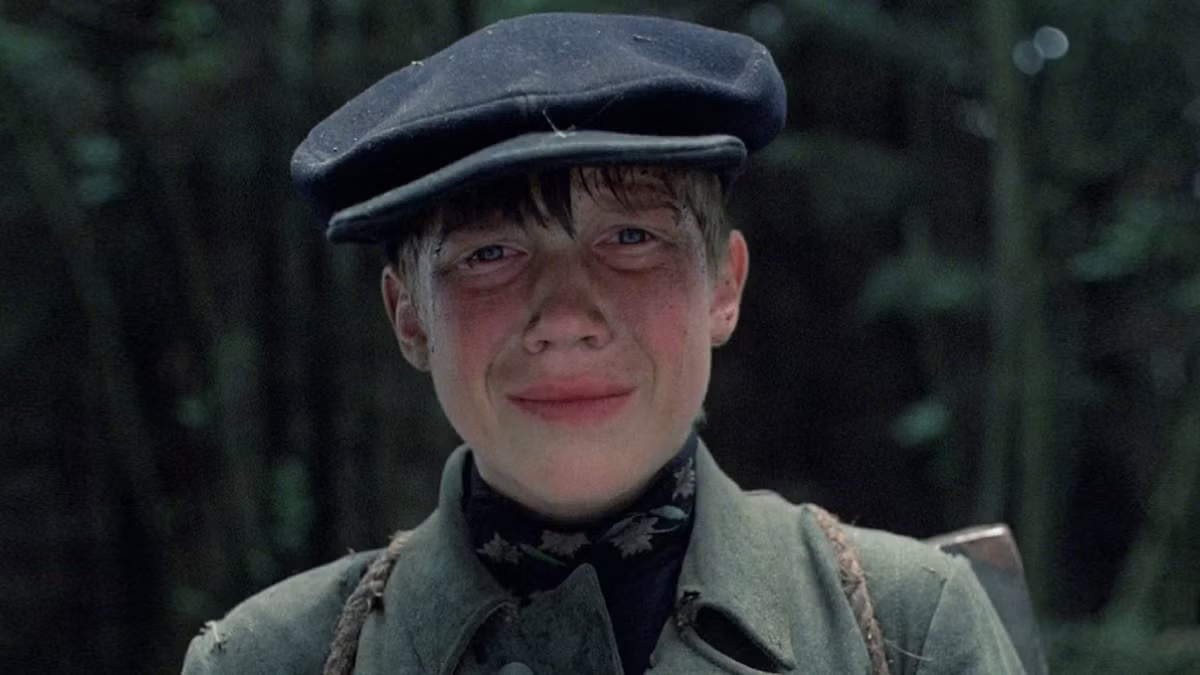
‘Come and See’ (1985)

An easy pick for the #1 spot, since it’s just about always discussed whenever the topic of heavy/depressing movies is brought up, here’s Come and See, which is about World War II, seen through the eyes of a child. It’s a little like the similarly distressing Grave of the Fireflies in that regard, with a little more by way of combat seen here, since the main character joins a group of resistance fighters, but plenty of it, like that aforementioned animated film, is also about merely trying to survive in terrible circumstances.
Come and See takes its time, but very purposefully gets a little more surreal and/or nightmarish with every passing scene. By the end, the intensity of it all is truly overwhelming, and then you’re left feeling about as empty as a movie is ever likely to make you feel. “That’s war,” says Come and See, in turn making a great argument for why we like, just shouldn’t do the whole war thing anymore and stuff.