
10 Most Perfect Movies of the 21st Century, Ranked
As a warning, what follows is praise for movies that have already been praised a great deal, so there might not be too many surprises here. If you’re talking about movies that might well be perfect, though, or otherwise incredibly close to perfection, then the lack of surprises isn’t itself too surprising, because critics (and sometimes general viewers, too) get very excited and loud about masterpieces.
Emphasis on the critical acclaim over box office success, though, as a couple of these weren’t monumentally huge releases. Anyway, they’re all fantastic movies, and even if it’s harder to call something “more perfect” than something else, the way they’re ranked here is based on how easy it is to argue that each respective movie qualifies as a masterpiece, starting with the superb and ending with the untouchably great.
10
‘All of Us Strangers’ (2023)

Undoubtedly, All of Us Strangers is incredibly intense, and maybe even heavy, though in ways that are hard to fully go into without ruining what the film has up its sleeve. Saying it’s an exploration of grief wouldn’t be overstepping things, because the main character is someone who lost his parents when he was young, but then they reappear in his life somehow (at the age they were at when they died), and this brings up lots of understandably complex emotions.
There’s also a good deal of romance in All of Us Strangers, with another story playing out alongside the one about the parents, but that ends up being moving in surprising ways, too. But hey, since this film stars Paul Mescal, maybe that makes emotional devastation an inevitability, since he’s been a key part of various downbeat films (and at least one TV show) in the past.
9
‘The Dark Knight’ (2008)

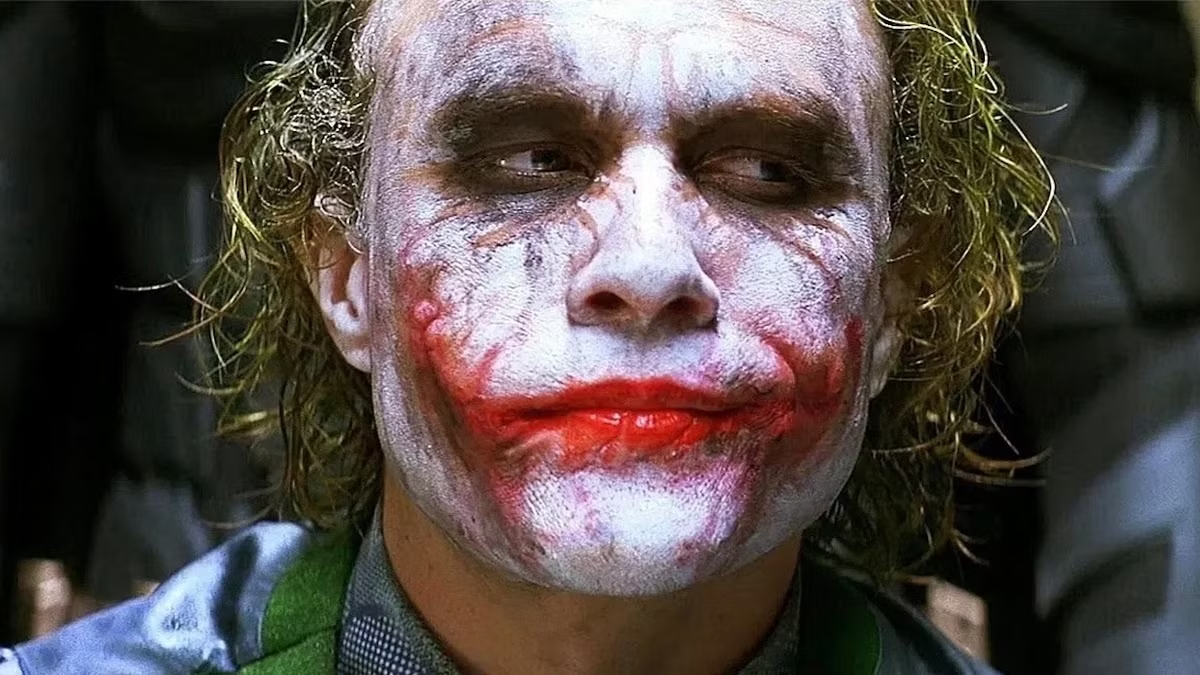
Yeah, yeah, The Dark Knight. It’s that Batman movie that made people start taking Batman a little more seriously, though that had happened to some extent with Batman Begins, but in hindsight, that one was really just a warm-up. The things that worked in Batman Begins worked even better in The Dark Knight, and all the things that didn’t quite work in the 2005 movie were improved considerably (or outright replaced) here.
If anything, The Dark Knight might’ve been too good for superhero movies overall, since a few, in its wake, also tried to be grittier and more intense than most superhero films, and fell a little short. That’s not The Dark Knight’s fault; just something that speaks to its influence. It got the level of grit right, and was also appropriately grounded, but not in ways that sacrificed entertainment value and spectacle. It’s a movie where the villain’s all about chaos, and it’s narratively unpredictable, but on a technical front, The Dark Knight is constantly precise and well-controlled.
8
‘Portrait of a Lady on Fire’ (2019)

On the other end of things to The Dark Knight pacing-wise is Portrait of a Lady on Fire, which really takes its time as a period drama/romance film, but certainly not in a way that risks being boring. There are two central characters, with one being a painter, and the other being a closed-off young woman who’s engaged, and is to be painted, but then certain feelings start to develop very, very slowly.
It’s subtle, but that’s not something you often see in movies about falling in love (especially rom-coms, which speed through the getting together and then breaking up and then making up processes), and so Portrait of a Lady on Fire feels particularly real. It’s also a striking movie as far as the visuals go, and it uses what sounds like a fairly barebones narrative to explore and/or reveal a host of far more complicated emotions.
7
‘There Will Be Blood’ (2007)

You do get some blood in There Will Be Blood, but not a lot (in the title’s defense, it never specified the amount of blood that there would be). That’s okay, though, since what you do mostly get is a slow-burn drama really about one man and the moral depths he’s willing to sink to, but it’s done on a scale that also makes the film feel like something of an epic.
Regardless of how you want to define it, There Will Be Blood is unusual, even if you can compare ideas and certain narrative beats found within to other stories. They’re all mixed together in a distinctive way, and also, the film is a great showcase for both Daniel Day-Lewis and Paul Dano, the former of whom does kind of dominate in the lead, but the latter’s also great (despite what you might’ve heard) in a supporting capacity.
6
‘Inglourious Basterds’ (2009)

There are almost too many World War II movies out there, or one might be able to make such an argument if they wanted to (it’s not something everyone feels). But Inglourious Basterds stands apart from the lot of them, proving particularly exciting and unexpected as a war movie because it doesn’t feel any obligation to stick to events as they actually happened.
That being said, Inglourious Basterds does still showcase certain horrors of World War II, and does find unique ways to drive home how much death was involved in the conflict, but it’s not what you’d expect. Even by the standards of Quentin Tarantino’s filmography (especially the movies made before 2009), it’s often not what you’d expect; only sometimes. There are certain trademarks of his here, sure, but the fact that he was willing to try something different here by tackling the war genre and also, for the first time, going well back in time to tell a story helped make Inglourious Basterds stand out.
5
‘Pan’s Labyrinth’ (2006)

Pan’s Labyrinth is equal parts beautiful and tremendously upsetting, since it has a story that boils down to a young girl having to flee a violent and uncomfortably tense life by entering a fantastical realm that’s itself pretty grim. Things that are bad in the outer world are reflected in interesting ways within the fantasy realm, and the film keeps certain things up to interpretation, but not in a frustrating manner.
It’s one of those things where regardless of what side you fall on, or how you see certain things, Pan’s Labyrinth excels. It’s the high point of Guillermo del Toro’s directing career to date, which is saying a great deal, considering how many great films he’s made, and it also feels like there’s a pretty strong chance Pan’s Labyrinth will hold up just as well in 50 or even 100 years as it does now, about 20 years on from its original release.
4
‘Parasite’ (2019)

For more than a quarter of a century now, Bong Joon-ho has continually had no fear of tackling social issues surrounding class and inequality, and did so perhaps most viciously and effectively in Parasite. It’s a film where a system feels like the villain, and all the characters are victims to some extent, though it is ultimately the case that those considered lower (or less valuable) by said system suffer more.
Which makes Parasite sound like it might be kind of miserable to watch, and parts of it certainly are, but it’s also a darkly funny and undeniably thrilling movie when it wants to be. It tackles a few different genres while going all over the place tonally, but Bong Joon-ho’s astoundingly steady direction keeps it all in line. It’s wild how something that doesn’t miss a beat can also walk to a rhythm that’s entirely unprecedented, but Parasite is indeed something special.
3
‘Spirited Away’ (2001)
If you’re only ever able to watch one anime film, first off, that’s terrible and you should start looking for loopholes, but if there are no holes to loop and it really just has to be the one movie, make it Spirited Away. This is about as beautiful and approachable as they come, also being one of those animated movies that doesn’t just feel like it’s aimed at kids, by any means, even if kids can enjoy it with the whole coming-of-age/growing-up angle it’s got going narratively.
The story could be uninteresting, though, and the characters similarly bland, and Spirited Away would nevertheless remain an animated modern classic, since it’s so visually stunning and memorable on a music front, too. It’s got everything, since you can analyze the hell out of it or just get lost in its world, and it’s understandable why it’s the most well-known thing Hayao Miyazaki has ever directed.
2
‘Whiplash’ (2014)

An unfathomably tight film, so much so that it puts most thrillers to shame as far as intensity is concerned (without itself being a thriller), Whiplash is a perfect movie about a young man trying to become perfect in his chosen field: drumming. Or, if not perfect, he wants to be good enough to be considered one of the greats, and he finds an instructor who is maybe even more determined (somehow) to make his students great.
In Whiplash, everything builds in intensity from scene to scene, and then the film ends on an absolute high, too.
And the film is really just a psychological battle between these two, with everything building in intensity from scene to scene, and then the film ends on an absolute high (or low, depending on your outlook). Whiplash might not sound huge on paper, and it tells a story that was, admittedly, originally a short film, but the execution here is what makes it all genuinely masterful.
1
‘The Lord of the Rings: The Return of the King’ (2003)

As a trilogy, The Lord of the Rings is exceptional for all the obvious reasons, but if you want to highlight one film from that trilogy as perhaps the best or overall “most” perfect, then it might as well be The Return of the King. It’s the third one, so things do get particularly big, with this one being especially heavy on the war side of things, but The Return of the King doesn’t forget about being emotional, either.
It’s the balance of still (to this day) remarkable spectacle and action with all the emotional highs needed, and a sense of exactly how to conclude things that makes The Return of the King special. If you wanted a more comprehensive breakdown of everything in the movie that’s good, you might as well just make a list of everything that happens in the movie. So much more could be said, but none needs to be. The end.


