
10 Lousiest Action Movies of All Time, Ranked
I’ve watched a lot of action movies that promise spectacle and leave nothing behind except noise. Explosions, chase scenes, and big set pieces are supposed to create momentum, but when the writing collapses, none of that matters. What makes a bad action movie frustrating is not just weak acting or bad effects; it’s the feeling that the film has no understanding of why action works in the first place.
The stakes feel artificial, characters react without logic, and scenes exist only to fill runtime instead of meaningfully pushing the story forward. Some of these films had big budgets, recognizable franchises, or popular stars, which makes their failure even harder to ignore. Others misunderstand their audience entirely and get confused with the idea that people watch movies based on their favorites starring in those. This list looks at action movies that didn’t just miss the mark but actively worked against themselves in delivering the lousiest scenes of all time.
10
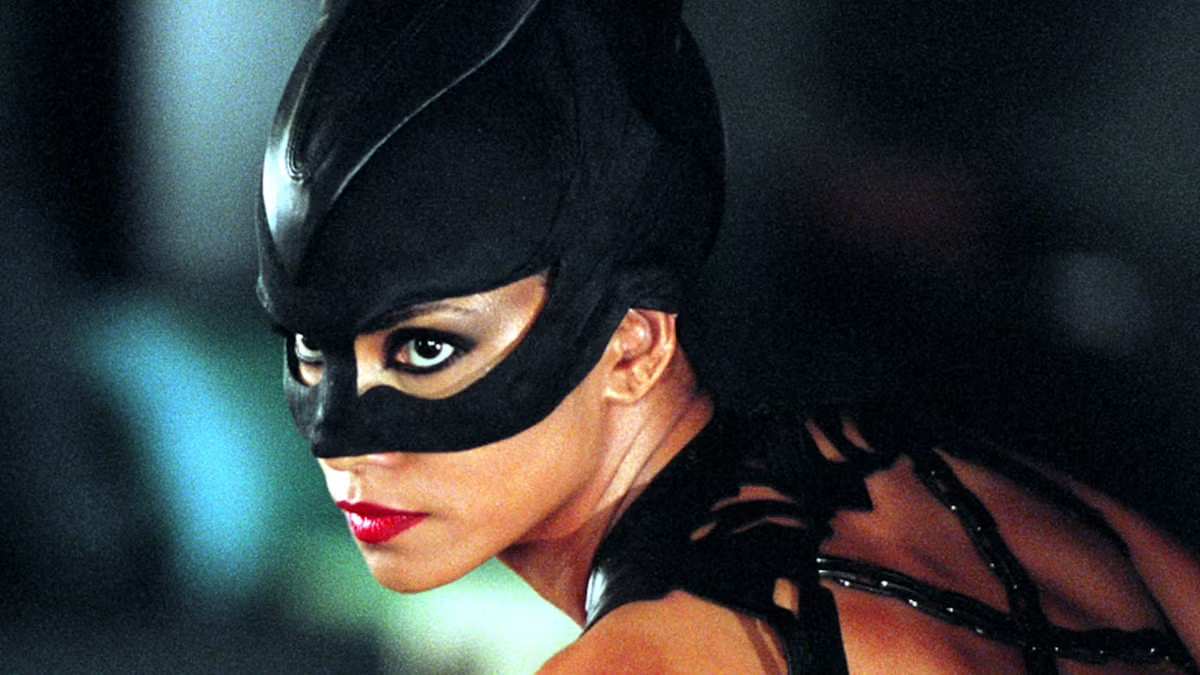
‘Catwoman’ (2004)

Catwoman collapses as an action film because it never establishes a coherent internal logic for its protagonist, which immediately weakens every major sequence built around her. Patience Phillips (Halle Berry) gains superhuman abilities, but the film never defines how those abilities function or what they cost her, so the action lacks tension because nothing is ever at stake.
Fight scenes unfold without escalation, and danger feels cosmetic rather than real. You feel that you are just watching a movie without feeling anything. The heavy reliance on early-2000s CGI further distances the audience, since the visual effects flatten physical movement instead of enhancing it. Moreover, rapid editing cuts away from impact rather than building toward it, which makes combat feel disjointed and weightless. By the time the film reaches its climax, the action has lost all narrative purpose, and everything else just exists only for its own sake.
9
‘Batman & Robin’ (1997)

Batman & Robin treats the action sequences as decoration rather than storytelling, and that decision undermines every major sequence in the film. Bruce Wayne (George Clooney) and his allies face constant threats, but the tone refuses to acknowledge danger in any meaningful way. It all just looks shallow. Characters deliver jokes during moments that should carry urgency, which drains tension before it can form.
The visual excess, from neon lighting to exaggerated set design, overwhelms the frame and prevents scenes from developing rhythm or momentum. Action sequences are repetitive because they lack emotional stakes, and conflict never leaves a lasting mark on the characters involved. Instead of reinforcing themes or relationships, the action exists as noise and turns what should be thrilling into something exhausting and hollow.
8
‘Speed 2: Cruise Control’ (1997)

Speed 2: Cruise Control misunderstands the foundation of its predecessor and replaces that urgency with scale. The movie mistakenly assumes that a larger setting will automatically generate excitement, but unfortunately, it does not happen. Annie Porter (Sandra Bullock) finds herself trapped in a situation that should feel dangerous, yet the cruise ship setting eliminates the constant forward pressure that defined the original film.
The ship’s slow movement drains all the built-up suspense, which causes action scenes to stretch rather than escalate. The antagonist lacks a strong presence, so destruction feels impersonal and repetitive instead of threatening. Without a clear ticking clock or tightening stakes, the film drifts from one large set piece to the next, and momentum never builds. The result is an action sequel that feels inert despite its size.
7
‘G.I. Joe: The Rise of Cobra’ (2009)

G.I. Joe: The Rise of Cobra struggles because it never commits to a consistent tone, and that confusion directly affects how its action plays out. Duke (Channing Tatum) operates in a world filled with advanced weapons and exaggerated villains, but the film fails to establish rules that govern this universe. Because of that, action scenes feel arbitrary, since characters survive explosions and combat without consequence.
The editing prioritizes only speed over clarity, which makes it difficult to track physical space or understand how one sequence connects to the next. Instead of using action scenes to deepen relationships between characters or advance the plot with purpose, the film relies on constant visual overload. Movement in a film becomes meaningless when nothing within it matters.
6
‘Fireproof’ (2008)

Image via Samuel Goldwyn Films/Affirm Films
Although Fireproof is not a traditional action movie, it attempts to rely on action-oriented scenarios, particularly firefighting sequences, without understanding how to construct them cinematically. Caleb Holt (Kirk Cameron) is placed in situations that should feel dangerous, but the film frames these moments as demonstrations that, too, the ones without any emotion.
The editing and camera placement failed to create any thrill in the audience, so the moments that should feel intense end up feeling flat. Scenes are structured to reinforce some kind of a message instead of allowing tension to develop naturally, which removes any sense of risk. When action is stripped of consequence and realism, it stops functioning as action altogether. The film becomes a clear example of how intention alone cannot replace craft, and that’s exactly what happened with Fireproof.
5
‘Mortal Kombat: Annihilation’ (1997)

Mortal Kombat: Annihilation collapses almost immediately because it abandons the basic rules that grounded the first film. Again, the action scenes somehow feel too chaotic to be real rather than purposeful. Liu Kang (Robin Shou) is positioned as the emotional and physical center of the story, yet the film rushes through plot points so quickly that his arc never stabilizes.
The fight scenes in the movie follow one another without buildup, and victories come without effort, which removes any sense of danger. Poor visual effects and unfinished choreography further weaken the action, since movements feel artificial and disconnected from physical space. The combat scenes lose clarity and do not gain any sort of intensity, which can be caused by lousy editing. Rather than escalating conflict, the film piles encounters on top of each other, leaving the audience overwhelmed but never engaged.
4
‘The Legend of Hercules’ (2014)

The Legend of Hercules fails miserably as an action film because it strips its main character of any emotional importance in the entire movie. Hercules (Kellan Lutz) moves through battles and betrayals with little resistance, and somehow it all looks predictable when it should have looked at least real or dramatic. The film relies heavily on slow motion and stylized combat, but we all could see that these techniques are used to mask weak choreography rather than enhance it.
Action scenes lack strategic structure, so fights feel interchangeable and directionless throughout. The emotional stakes never rise because character motivations remain thin, and without that foundation, the action has nothing to support it. Instead of building tension through escalation, the film repeats the same visual beats until momentum disappears entirely.
3
‘Expendables 2’ (2012)

The Expendables 2 mistakes familiarity for substance, and wrongfully assumes that star power alone can sustain its action. Barney Ross (Sylvester Stallone) and his team move from one firefight to another without meaningful variation, which turns violence into another routine task. The film leans heavily on exaggerated body counts and one-liners, but these elements replace the developed tension.
Action scenes feel mechanically assembled, with little concern for pacing or consequence. Characters survive situations that should carry weight, and that predictability drains excitement from every confrontation. You always know that nothing bad is going to happen to the main cast. Without escalation or emotional stakes, the action becomes repetitive, and the film begins to feel longer than it is.
2
‘Wild Wild West’ (1999)

Wild Wild West struggles as an action film because it never decides what kind of action movie it wants to be, and that confusion undermines every major set piece. James West (Will Smith) operates in a world filled with steampunk gadgets and exaggerated threats, yet the film treats danger as a joke more often than a challenge. Action scenes interrupt the story instead of advancing it, so whenever you are onto developing some momentum for the film, it all just dilutes down because of the lousy filler scenes.
The humor in the movie looks misfit, and it clashes with the supposed stakes and the overall aura, so conflicts lose any value before they can develop suspense in the minds of the audience. Large set pieces exist for spectacle alone, and without narrative pressure, they feel empty. The result is an action film that moves constantly but never builds.
1
‘Superman IV: The Quest for Peace’ (1987)

Superman IV: The Quest for Peace fails on a fundamental level because it reduces one of cinema’s most powerful heroes to a collection of underwhelming sequences. Superman (Christopher Reeve) faces threats that lack scale, coherence, and consequence, which makes the action scenes feel trivial rather than epic. There was another reason, which was the budget limitations that were painfully visible throughout the film.
The overall pacing of Superman IV undermines tension, since conflicts resolve too easily and without escalation that you wondering what has just happened. Action scenes, on the other hand, are completely disconnected from characters and themes. As a result, the movie weakens the very idea of Superman as an action hero.

Superman IV: The Quest for Peace
- Release Date
-
July 24, 1987
- Runtime
-
90 minutes
- Director
-
Sidney J. Furie
- Writers
-
Lawrence Konner, Mark Rosenthal
-

Christopher Reeve
Clark Kent / Superman
-


