
10 Greatest Movie Trilogies of the Last 50 Years, Ranked
For the past fifty years, cinema has delivered trilogies that don’t just tell great stories. They define eras, shape genres, and showcase how filmmaking can evolve across multiple chapters. The best trilogies build their worlds with intention, deepen their characters with each installment, and leave audiences with the rare satisfaction of witnessing a complete narrative unfold. From sweeping fantasies to grounded dramas and intimate romances, these trilogies show how powerful storytelling becomes when it’s given room to grow without losing its focus.
For this list, we’re only including trilogies that stand as contained stories or have no direct continuation, so while something like The Matrix and Jason Bourne are excluded due to their follow-ups, the Star Wars original trilogy makes the cut because it forms a complete narrative on its own. This approach ensures each entry represents a cohesive, intentionally structured three-part arc. These are the trilogies that not only resonated with audiences but also shaped the modern cinematic landscape through their storytelling, performances, and cultural impact.
10
‘Unbreakable’ Trilogy (2000–2019)

M. Night Shyamalan’s Unbreakable Trilogy tells three intertwined stories about extraordinary individuals living in an otherwise ordinary world. Unbreakable introduces David Dunn (Bruce Willis), an everyday man who discovers he has superhuman strength, all while unknowingly forming a fateful bond with Elijah Price (Samuel L. Jackson), a brilliant but fragile man obsessed with comic-book mythology. Split shifts focus to Kevin Wendell Crumb (James McAvoy), a man with multiple personalities whose darkest persona, The Beast, emerges with terrifying power. The trilogy concludes with Glass, where the three men collide in a fateful psychological showdown.
Shyamalan always envisioned Unbreakable as a trilogy, and he finally brought it to fruition. Unbreakable was released ahead of its time, way before the superhero movie boom, and its conclusion, Glass, reframes and deconstructs the superhero trope that has become all too familiar. Its unique approach to the genre made it compelling, and the performances are all standouts: Bruce Willis brings quiet strength to David Dunn, Samuel L. Jackson delivers one of his most memorable roles as the calculating and tragic Elijah Price, and James McAvoy’s shape-shifting performance should have won him an Oscar. It rightfully earns a place among the most distinctive and unconventional trilogies of the last 50 years.
9
‘How to Train Your Dragon Trilogy’ (2010–2019)

The How to Train Your Dragon trilogy follows Hiccup (Jay Baruchel), a young Viking who forms an unlikely bond with a rare dragon named Toothless, reshaping the relationship between humans and dragons across three sweeping adventures. The first film charts their friendship and the shift from fear to understanding in Berk. The sequel expands the world, introducing new threats, long-lost family ties, and Hiccup’s growth as a leader. The third film brings the story to a bittersweet close as Hiccup and Toothless face a villain who forces them to choose between loyalty and freedom.
This animated film stands out thanks to its emotional storytelling, nuanced performances, and cinematic craftsmanship that rivals many live-action epics. All the films in the trilogy received Rotten Tomatoes scores above 90%. The animation, especially in the flight sequences, created some of the most visually awe-inspiring moments in modern animation. The voice cast is also impressive, from Baruchel to seasoned pros like Gerard Butler and Cate Blanchett. Each installment matures alongside its characters, tackling themes of leadership, identity, and love with unexpected depth. Together, the How to Train Your Dragon trilogy tells a heartfelt coming-of-age narrative about courage, compassion, and what it means to let go.
8
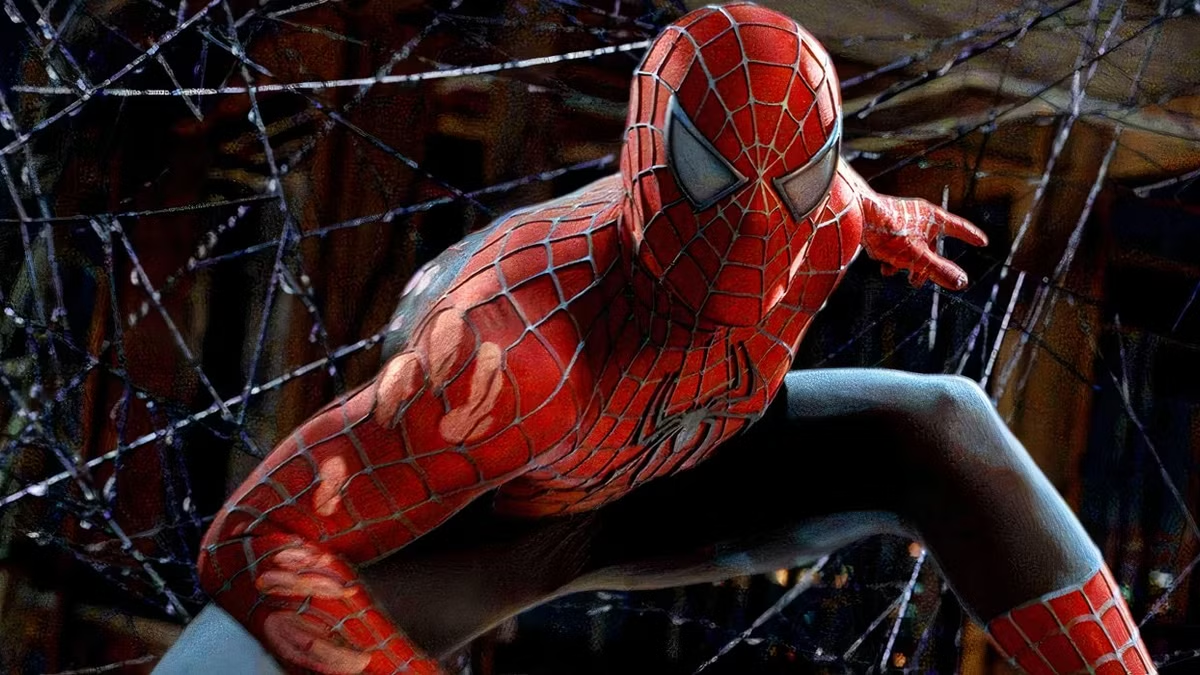
‘Spider-Man’ Trilogy (2002–2007)

Sam Raimi’s Spider-Man trilogy tells Peter Parker’s (Tobey Maguire) journey from an awkward teenager to a burdened hero balancing responsibility and his exceptional powers. Across the three films, he faces iconic villains like the Green Goblin (Willem Dafoe), Doctor Octopus (Alfred Molina), Sandman (Thomas Haden Church), and Venom (Topher Grace) while navigating complicated relationships with Mary Jane Watson (Kirsten Dunst) and his friend-turned-foe Harry Osborn (James Franco).
As one of the earliest films to lead the superhero genre trend, the trilogy is beloved for its earnest tone, committed performances, and foundational role in shaping modern superhero storytelling. Tobey Maguire brings sincerity and vulnerability to Peter, while seasoned actors like Willem Dafoe and Alfred Molina deliver unforgettable villain performances. As one of the most inventive directors working today, Raimi’s stylistic flourishes from his dynamic camera work, expressive visuals, to heartfelt sincerity. They are all perfect for a comic-book adaptation. Even decades later, the Spider-Man trilogy remains a cornerstone of the genre.
7
‘Back to the Future’ Trilogy (1985–1990)

The Back to the Future trilogy follows Marty McFly (Michael J. Fox) and Doc Brown (Christopher Lloyd) as they travel back and forth in time, causing ripple effects. The first film sends Marty from 1985 back to 1955, where he accidentally disrupts his parents’ romance and must fix the timeline before he blinks out of existence. The second chapter ramps things up with parallel timelines and a darker alternate 1985 ruled by Biff Tannen. Part three transports Marty and Doc to 1885 for a Western-style adventure that wraps up the duo’s story.
The Back to the Future trilogy is so enduring thanks to its clever storytelling and charismatic performances. Michael J. Fox gives Marty a perfect balance of charm and impulsiveness, while Christopher Lloyd’s eccentric energy as Doc Brown became instantly iconic. Robert Zemeckis and Bob Gale’s scripts weave humor, heart, and tight narrative structure into three films that feel perfectly interconnected. The trilogy’s imaginative world-building, technical innovation, and genuine emotional core have cemented it as one of the most beloved and rewatchable ever made.
6
‘The Dark Knight’ Trilogy (2005–2012)

The Dark Knight Trilogy follows Bruce Wayne’s (Christian Bale) evolution from a billionaire consumed by vengeance to a symbol fighting to save Gotham from crime and moral bankruptcy. His journey starts in Batman Begins, where he creates the hero and saves Gotham from Scarecrow (Cillian Murphy) and Ra’s Al Ghul (Liam Neeson). In The Dark Knight, he’s pushed to the limits by the Joker (Heath Ledger), while in The Dark Knight Rises, an older and worn-down Bruce confronts Bane (Tom Hardy), who takes the city hostage.
Widely acclaimed as game-changing blockbusters, the trilogy’s greatness comes from its ambitious and mature storytelling, powerhouse performances, and influence on cinema. Christian Bale leads the films with a layered portrayal of Bruce Wayne, while Heath Ledger’s Joker remains one of cinema’s most chilling and mesmerizing villain performances. Christopher Nolan’s grounded approach and reliance on practical effects helped redefine what superhero films could be. Its influence can still be felt in nearly every Hollywood tentpole that followed, solidifying the trilogy as one of the genre’s defining achievements.
5
‘Star Wars’ Original Trilogy (1977–1983)

The original Star Wars trilogy begins with a classic hero’s journey as Luke Skywalker (Mark Hamill) rises from a farm boy on Tatooine to the galaxy’s central hero against the Galactic Empire. A New Hope introduces the heroes, Luke, Princess Leia (Carrie Fisher) and Han Solo (Harrison Ford) as they join the fight against Darth Vader. The Empire Strikes Back deepens the story, which includes a shocking revelation of Darth Vader’s identity. Return of the Jedi brings everything to a close as the Rebels mount one final stand, and Luke embraces his destiny.
The trilogy is so iconic for its storytelling, visual effects and cultural impact. George Lucas revolutionized visual effects, sound design, and world-building, setting a new benchmark for blockbuster filmmaking. More importantly, the trilogy’s themes, destiny, redemption, and the power of hope, gave it emotional depth that resonated across generations. The trilogy influenced not just sci-fi but the entire Hollywood studio system. Even with the massive expansion of the Star Wars universe, these three films stand as a self-contained narrative masterpiece that continues to shape the DNA of modern cinema.
4
‘Before Trilogy’ (1995–2013)
Richard Linklater’s Before Trilogy follows Jesse (Ethan Hawke) and Céline (Julie Delpy) at three distinct points in their lives, beginning with their spontaneous meeting on a train and a night spent wandering Vienna in Before Sunrise. Nine years later, in Before Sunset, they reunite in Paris, where unresolved feelings and new responsibilities collide during a single afternoon. Before Midnight finds them in Greece, now years into a relationship and confronting the messier realities of love.
The trilogy’s lasting power comes from its authenticity, intimate writing, and the extraordinary chemistry between Ethan Hawke and Julie Delpy. Their performances are so natural that audiences feel like they are eavesdropping on a real couple having a conversation. It helps that together with Linklater, they develop the script themselves. Linklater’s minimalistic directing style, with long takes and natural settings, gives the film a realistic quality. Each film matures with its characters and audience, turning the series into a rare cinematic portrait about love and time.
3
‘Three Colours’ Trilogy (1993–1994)

Krzysztof Kieślowski’s Three Colours Trilogy presents three loosely connected stories inspired by the French ideals of liberty, equality, and fraternity. Blue follows Julie (Juliette Binoche), a woman grappling with the sudden loss of her husband and child as she attempts to rebuild her identity in solitude. White sees Karol’s (Zbigniew Zamachowski) bitterly comic journey from humiliation to revenge after a painful divorce. Red closes the trilogy with the story of Valentine (Irene Jacob), a young model whose chance encounter with a reclusive judge leads to unexpected reflections.
The trilogy is celebrated for its elegant storytelling, restrained yet powerful performances, and its influence on modern European arthouse cinema. Juliette Binoche, Julie Delpy, and Zbigniew Zamachowski anchor their respective films with deeply human portrayals that elevate everyday moments into something poetic. Kieślowski’s use of color, music, and visual symbolism is delicate but evocative, revealing emotional truths without ever becoming heavy-handed. The trilogy is exceptional for its ability to explore complex themes with subtlety and relevance. It remains a masterclass in how intimate stories, when thoughtfully told, can feel universally profound.
2
‘The Lord of the Rings’ Trilogy (2001–2003)

The Lord of the Rings trilogy adapts J.R.R. Tolkien’s epic fantasy into a satisfying, Oscar-winning narrative about the quest to destroy the One Ring. Across Middle-earth, a fellowship of hobbits, humans, elves, and dwarves journeys from peaceful Shire meadows to the shadowed lands of Mordor. As the fellowship breaks, the films follow Frodo (Elijah Wood) and Sam’s (Sean Astin) painful trek to Mount Doom with the treacherous Gollum (Andy Serkis), Aragorn’s (Viggo Mortensen) rise to reclaim the throne of Gondor, and the larger war against Sauron’s forces.
The trilogy is widely regarded as one of cinema’s greatest achievements because of its unmatched world-building, emotional richness, and technical innovation. Sir Peter Jackson balances intimate character moments with massive-scale storytelling. Weta’s groundbreaking visual effects, sweeping New Zealand landscapes, and Howard Shore’s iconic score created a cinematic world that set new standards for fantasy filmmaking. Its themes of friendship, sacrifice, courage, and the idea that even the smallest person can change history resonate across generations. The trilogy amassed 17 Oscar wins, including 11 won by The Return of the King, and remains a landmark of modern cinema.
1
‘The Godfather’ Trilogy (1972–1990)

The Godfather trilogy chronicles the rise and decline of the Corleone crime family across several decades. The first film follows Michael Corleone’s (Al Pacino) reluctant descent from war hero to ruthless leader, while Part II sees both his cold consolidation of power and flashbacks to young Vito Corleone’s (Robert De Niro) immigrant beginnings. Part III, set years later, finds an aging Michael seeking legitimacy and redemption.
Francis Ford Coppola created a towering achievement with the trilogy. Its operatic scope and meticulous craftsmanship are unmatched. The performances from Marlon Brando, Al Pacino, Robert De Niro, and Diane Keaton are career-defining, while Gordon Willis’s beautifully lit cinematography and Nino Rota’s mournful score create an unforgettable aesthetic. The Godfather and Part II are often hailed among the greatest films ever made, and the recently released The Godfather Coda: The Death of Michael Corleone fulfills Coppola’s vision for Michael’s tragic arc. As a trilogy, it remains a blueprint for epic, character-driven filmmaking.


