
10 Action Movies With the Greatest Dialogue Ever
Action movies typically charm through shootouts and stunts, though the genre’s classics also understand the power of dialogue. It’s curious because “dialogue” is not what one immediately thinks when considering the action genre. Yet, a perfectly delivered line can define a character, intensify a confrontation, or capture the entire spirit of a movie in a single moment.
The greatest action dialogue is quotable, sharp, emotionally revealing, and deeply tied to character. With that in mind, this list looks at some of the best-written action flicks ever, whether that’s thanks to their zinging one-liners, a devious villain’s chilling monologue, or a quiet exchange between rivals who understand each other too well.
‘Die Hard’ (1988)

“Yippee-ki-yay, motherf—r.” Bruce Willis turns in perhaps the most iconic action performance of the late ’80s here as New York cop John McClane, laying the foundation for a multi-decade franchise. Our hero travels to Los Angeles hoping to reconcile with his wife (Bonnie Bedelia) during her company’s Christmas party at Nakatomi Plaza, but gets more than he bargained for when a group of terrorists led by the sophisticated Hans Gruber (Alan Rickman) takes the building hostage.
Here, nearly every major character gets memorable lines, and the screenplay constantly balances macho bravado with wit, exhaustion, fear, and sarcasm. On the one hand, McClane is more human than your average ’80s protagonist. Rather than being superhuman and perfectly collected, he complains, panics, mutters to himself, and uses humor as a survival mechanism. Gruber, by contrast, is sophisticated, theatrical, intelligent, and calmly cruel, his dialogue almost literary.
‘Lethal Weapon’ (1987)

“I’m too old for this s—t.” This smash hit saw Superman director Richard Donner teaming up with the then-unknown young screenwriter Shane Black, who would go on to pen the likes of Kiss Kiss Bang Bang and Iron Man 3. Lethal Weapon pairs two wildly different LAPD detectives: Martin Riggs (Mel Gibson), a reckless cop haunted by the death of his wife, and Roger Murtaugh (Danny Glover), a cautious veteran counting the days until retirement. While investigating a drug smuggling ring, their uneasy partnership slowly evolves into friendship.
The actors’ chemistry does most of the heavy lifting. In particular, their conversations constantly bounce between humor and genuine pain, elevating this above standard cop movie fare. One moment they’re trading insults or sarcastic observations, and the next they’re discussing loneliness, fear, or mortality. In other words, their banter provides both comic relief and character development.
‘Predator’ (1987)

“If it bleeds, we can kill it.” Before reshaping blockbuster action filmmaking with Die Hard, director John McTiernan made his mark on action sci-fi with this lean, mean banger. Predator follows an elite military rescue team sent into a Central American jungle on a covert mission. There, they discover they are being stalked by an invisible extraterrestrial hunter with high-tech weapons that views humans as trophies.
Along the way, Arnold Schwarzenegger’s Dutch gradually shifts from confident leader to desperate survivor, and his dialogue reflects that transformation. The famous line about bleeding captures the moment when the team realizes their enemy might not be invincible after all. It makes for a stirring action moment, the underdogs understanding they still have a shot. On top of that, there are a bunch of famously goofy but awesome lines, like “Get to the chopper!” and “You are one ugly motherf—r.”
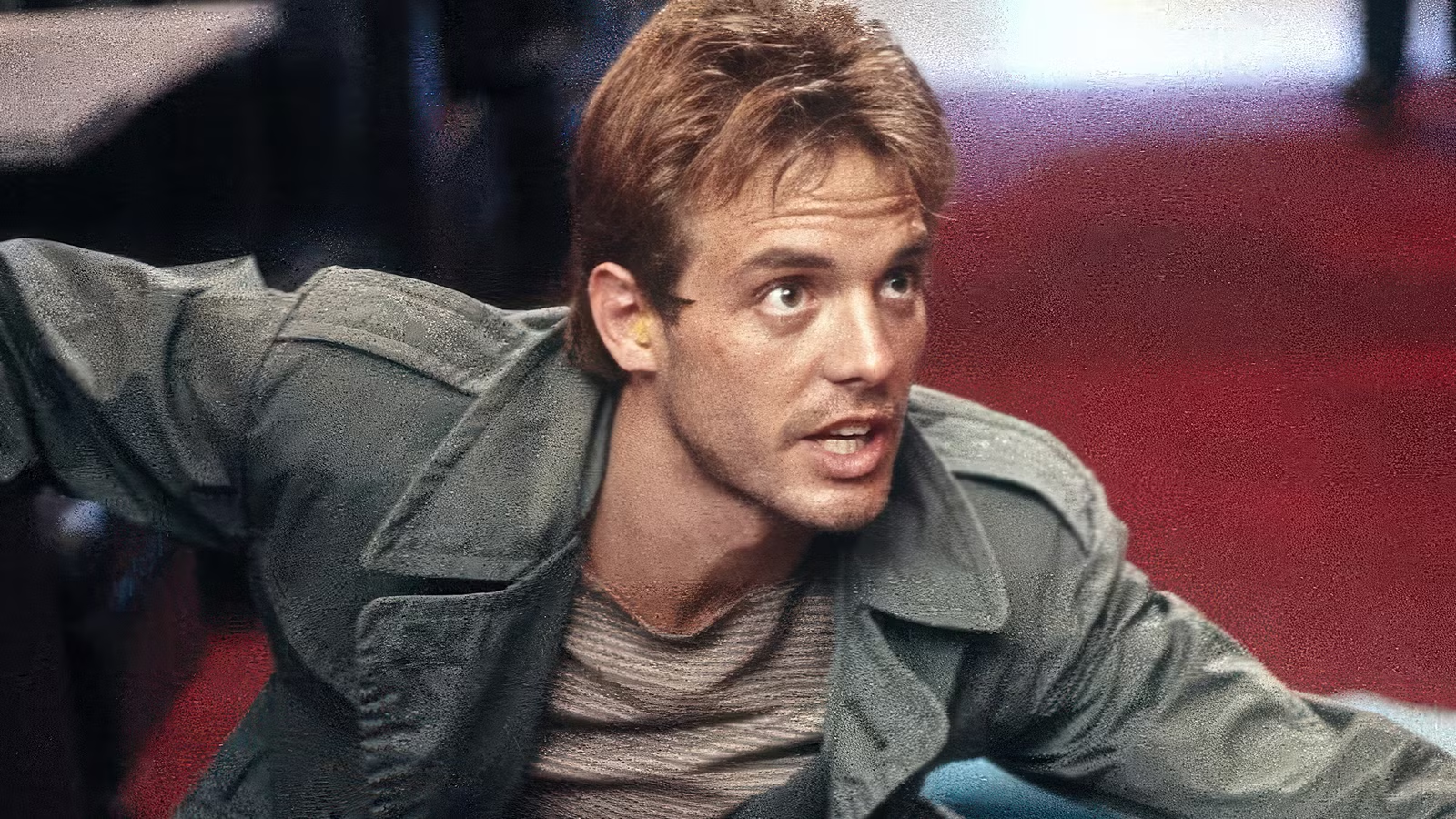
‘The Terminator’ (1984)

“I’ll be back.” Arnie strikes again. In the first Terminator movie, ordinary LA waitress Sarah Connor (Linda Hamilton) suddenly becomes the target of a relentless cyborg assassin sent from the future. A resistance fighter named Kyle Reese (Michael Biehn) travels back in time to protect her, revealing that Sarah’s unborn son will one day lead humanity’s war against machines. Refreshingly, the movie doesn’t rely on endless monologues or info dumps.
Instead, its dialogue is lean, efficient, and often unforgettable. Reese sounds believably frantic, traumatized, and exhausted; his dialogue sounds emotionally lived-in rather than overly polished. That said, it’s Schwarzenegger who steals the show. He’s perfectly cast as the emotionless killer robot. He speaks only 58 words across 17 lines, yet pretty much all of them are iconic, like his cold delivery of “I’m a friend of Sarah Connor” and, of course, his promise to return.
‘Mad Max: Fury Road’ (2015)

“Oh, what a day! What a lovely day!” This two-hour chase sequence takes place in a post-apocalyptic wasteland where warlord Immortan Joe (Hugh Keays-Byrne) controls the scarce water supply. His one-time lieutenant Imperator Furiosa (Charlize Theron) escapes with several of Joe’s captive wives, forming an uneasy alliance with the drifter Max Rockatansky (Tom Hardy) during a relentless desert chase. The dialogue is minimal and impressively economical, though still striking.
Characters speak in fragments, slang, and emotionally loaded statements that hint at larger histories without spelling everything out. Max is haunted but capable of growth; Furiosa is flinty and powerful, but still human. On top of revealing character, the movie’s lines feel practically mythic. The War Boys’ ecstatic battle cries (“Witness me! “), Joe’s authoritarian proclamations, and Max’s terse remarks all reinforce the film’s strange, brutal world.
‘Raiders of the Lost Ark’ (1981)

“It’s not the years, honey. It’s the mileage.” Possibly Steven Spielberg‘s most straightforwardly entertaining movie, Raiders of the Lost Ark introduces us to the whip-wielding archaeologist (Harrison Ford) who travels the globe searching for ancient artifacts before they fall into the wrong hands. When the U.S. government learns that the Nazis are searching for the biblical Ark of the Covenant, Jones embarks on a perilous journey from South America to Cairo to stop them.
The movie pays homage to classic boys’ adventure stories, but raises their stakes with more elaborate set pieces, more compelling characters, and a script jam-packed with witty and charming lines. Indy reacts to danger with dry wit and frustration, and Ford delivers everything with the perfect amount of weary sarcasm. His dynamic with Karen Allen’s Marion Ravenwood is another enormous strength. Their conversations feel flirtatious, combative, funny, and emotional all at once.
‘The Dark Knight’ (2008)
“Why so serious?” The zenith of superhero cinema, The Dark Knight sees Batman (Christian Bale) confronting his toughest foe yet (Heath Ledger), who seeks not wealth or power but chaos itself. As the Joker’s schemes escalate, Batman and his allies struggle to maintain order while confronting impossible moral dilemmas. The film fires on all cylinders, from the stunts and cinematography to the performances and the writing, with Christopher and Jonathan Nolan delivering perhaps the most thematically rich script in the whole genre.
The screenplay delves deep into themes of vigilantism, escalation, terrorism, idealism, “necessary evils,” and “noble lies.” The Joker, in particular, uses words to psychologically dismantle the other characters. So many lines became part of the zeitgeist: “Introduce a little anarchy,” “Some men just want to watch the world burn,” and “You either die a hero or live long enough to see yourself become the villain.”
‘Heat’ (1995)

“Don’t let yourself get attached to anything you are not willing to walk out on in thirty seconds flat.” Heat tells the parallel stories of master thief Neil McCauley (Robert De Niro) and obsessive LAPD detective Vincent Hanna (Al Pacino). As McCauley prepares for one last heist with his professional crew, Hanna closes in on him, setting the stage for a collision between two men who recognize themselves in each other.
Indeed, the genius of the script is that the characters are mirror images, and this dynamic deepens the action thriller elements into real character drama. This comes through most clearly in the legendary diner scene. It’s built almost entirely on conversation, yet it carries the tension of a gunfight. The dialogue is mostly restrained and realistic throughout, which makes the occasional bursts of intensity even more powerful.
‘Pulp Fiction’ (1994)

“Say ‘what’ again!” Pulp Fiction intertwines multiple stories set within the Los Angeles criminal underworld, following hitmen, gangsters, and small-time crooks whose lives intersect in unpredictable ways. Characters discuss everything from fast food in Europe to television pilots and divine intervention, and practically every line is iconic: “That’s thirty minutes away. I’ll be there in ten,” “I’ma get medieval on your ass,” “Zed’s dead, baby. Zed’s dead”, and countless others.
On top of being unique, entertaining, and frequently hilarious, the conversations are also loaded with references to other films, giving the movie a strange postmodern edge. Yet this isn’t all style over substance. Some lines get surprisingly emotional or philosophical. The most striking example is Jules’ (Samuel L. Jackson) breaking down the meaning of Ezekiel 25:17 in the final scenes. “The truth is you’re the weak,” he tells us. “And I’m the tyranny of evil men.”
‘The Good, the Bad and the Ugly’ (1966)

“When you have to shoot, shoot. Don’t talk.” Sergio Leone‘s Western masterpiece takes place during the American Civil War and follows three gunslingers — Blondie (Clint Eastwood), Tuco (Eli Wallach), and Angel Eyes (Lee Van Cleef) — who compete to find a hidden fortune in Confederate gold. Each man forms temporary alliances while constantly plotting to outmaneuver the others. Leone often lets silence dominate scenes, but when characters speak, their words carry enormous weight.
Crucially, each of them is given a distinctive voice: Wallach is all manic energy, Van Cleef is unsettling, and Eastwood’s laconic delivery exudes cool confidence. Their lines are usually understated and fatalistic, building tension without being melodramatic. They’re often darkly funny, too. Characters insult, deceive, threaten, and mock each other in ways that feel timelessly entertaining, a perfect complement to Ennio Morricone‘s iconic score and Leone’s sweeping visuals.


