
10 Greatest Crime Movies Hollywood’s Golden Age Ever Produced
Crime movies have always been one of the most prolific genres in Hollywood. Even during the industry’s Golden Age (roughly between 1930 and 1959), with the censorial Hays Code strictly in place, filmmakers still found ways to satisfy audiences’ cravings for dark stories of rebellion. Throughout this era, Hollywood produced several of what are now remembered among the greatest crime films of all time.
From noir classics like The Maltese Falcon to Alfred Hitchcock gems like Dial M for Murder, these films are perfect case studies in how crime cinema was made during Hollywood’s Golden Age. Crime is shown in all its exciting splendor, moving through visually grim and morally grey narratives, until returning to a punishment for all lawbreakers and the restoration of justice. It may sound like an old-fashioned way to approach the genre, but if these masterpieces prove anything, it’s that it was a tried-and-true method for a reason.
‘The Maltese Falcon’ (1941)

Based on the 1930 novel by Dashiell Hammett, one of the most iconic pulp novelists in history, The Maltese Falcon was by no means the first film to feature noir-like elements. Film scholars and historians tend to agree, however, that it was the first major prototypical film noir of the Classic era, and that’s enough to make it a must-see for any and all cinephiles.
It’s one of those classic thrillers that are still masterpieces decades later, retaining the hard-boiled pulp and grit of the source material while adding plenty of its own sauce. John Huston‘s directorial debut is a landmark classic that’s frequently counted among the most influential films of all time. Anchored by Humphrey Bogart delivering some of the most memorable work of his career, it’s an essential noir and one of the most important entries in Hollywood’s Golden-Age filmography.
‘Dial M for Murder’ (1954)

Alfred Hitchcock saw the start of his hugely prolific career in his native United Kingdom, but he made the jump over the pond to Hollywood in 1940. His career and popularity only kept going up from there, and throughout the ’50s in particular, he had one of the strongest runs of any movie director in history. For proof, there’s Dial M for Murder, one of the best crime films the auteur ever directed.
It’s the kind of movie that makes it clear why people still refer to Hitchcock as the Master of Suspense. Bolstered by a legendary Grace Kelly performance, it’s a gripping single-location thriller that was unsurprisingly based on a successful stage play. Hitchcock makes the story feel entirely cinematic, however, keeping the sense of tension perfectly calculated while allowing Frederick Nott‘s screenplay to shine.
‘On the Waterfront’ (1954)

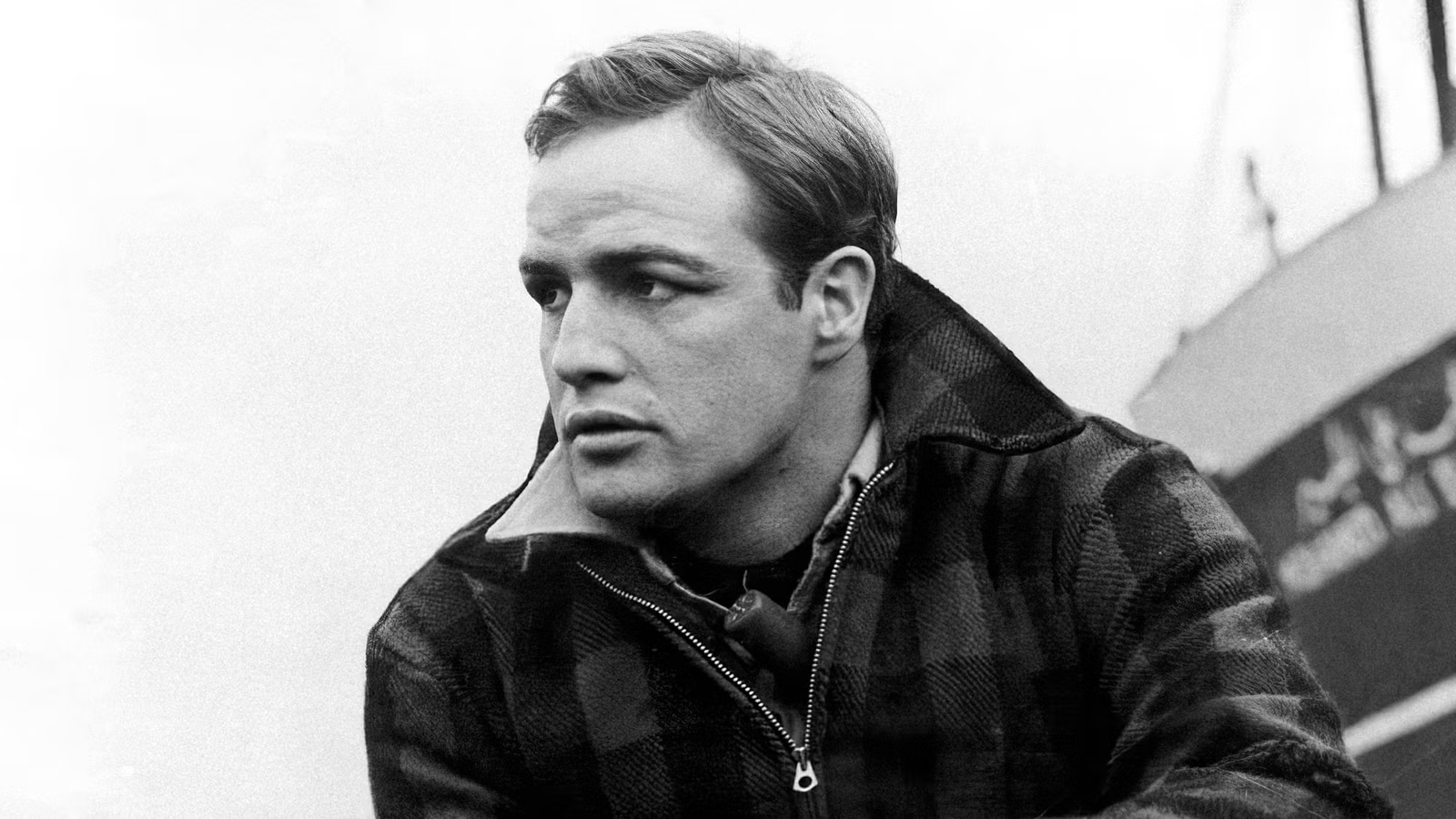
A Streetcar Named Desire catapulted Marlon Brando into superstardom, but On the Waterfront made it clear that he was more than just a great actor. Indeed, now looking back at the actor’s career—no matter how controversial he was as an individual—it’s easy to call him the greatest actor in film history. But it was this Elia Kazan masterpiece that planted the seed of that reputation in audiences’ minds and earned him a much-deserved Best Actor Oscar.
Brando’s revolutionary performance isn’t the only thing that On the Waterfront has going for it, however. Aesthetically electrifying, powerful in its use of melodramatic elements, and layered with complex themes of redemption and the fight against systemic corruption, this seminal picture is a thought-provoking gem guided with almost incomparable intelligence and heart.
‘I Am a Fugitive from a Chain Gang’ (1932)

While not typically regarded as a full-fledged addition to the pantheon of classic noir films, I Am a Fugitive from a Chain Gang nevertheless features enough noir elements to be considered a part of the genre. But regardless of any labels or classifications, one thing is undeniable: This is by far one of the greatest films of the ’30s, and a masterpiece that deserves far more love than it usually gets nowadays.
Based on a true story spanning several years, I Am a Fugitive offers a sharp critique of the American justice system that still feels surprisingly bold and outspoken (as well as tragically timely) almost a century after the movie’s release. After all, it was released before the Hays Code went into strict enforcement mode, as it’s fair to say that the film would have never been made under those kinds of guidelines. It’s one of the most perfect noir movies that almost nobody remembers today, and a classic that every cinephile should see at least once.
‘Some Like It Hot’ (1959)

Crime movies don’t need to be all somber, as proved by the many excellent crime comedies that have been made throughout Hollywood’s history. As far as the Hollywood Golden Age goes, crime comedies never really got any better than Billy Wilder‘s Some Like It Hot, one of those classic comedies that are still masterpieces today.
Wilder was always an audacious auteur far ahead of his time, never afraid to dance around the Hays Code. Much like its director, Some Like It Hot was also significantly ahead of its time, dealing with themes of gender in surprisingly progressive and layered ways. Add to that a number of hilarious gags and comedic set pieces; phenomenal black-and-white cinematography; and a trifecta of perfect performances by Marilyn Monroe, Jack Lemmon, and Tony Curtis, and you get one of the greatest comedies ever made.
‘White Heat’ (1949)

Due to the Code, crime movies rarely went as deep into their law-breaking characters’ psyches as many crime films made in the modern age. That only makes White Heat‘s deep dive into the psychology of its gangster protagonist all the more unique and admirable. This is far more than just a noir classic; it’s easily one of the greatest movies of Hollywood’s entire Golden Age.
James Cagney helps make White Heat’s finale one of the most explosive and memorable in the history of American cinema.
Led by a consistently jaw-dropping James Cagney, who helps make the film’s finale one of the most explosive and memorable in the history of American cinema, White Heat is the tragic story of one of this era of cinema’s most fascinating antiheroes. Deep, violent, melodramatic, and nothing short of groundbreaking, this cleverly plotted masterpiece should be considered essential viewing for everyone who loves crime films.
‘Witness for the Prosecution’ (1957)

Another Billy Wilder masterpiece that is also among the best movies of the 1950s, Witness for the Prosecution is a legal mystery melodrama sprinkled with elements of a courtroom drama, a dark comedy, and a film noir. This genre-juggling might have resulted in a complete mess of a movie in any other filmmaker’s hands, but in Wilder’s hands, it results in one of the most flawless Agatha Christie adaptations in movie history.
For one, the cast, which includes stars of the stature of Marlene Dietrich and Charles Laughton, is incredible. They bring tremendous force and momentum to this taut, perfectly executed creative triumph in a way that makes it as irresistibly funny as it is effectively thrilling. Full of perfectly-calculated twists, Witness for the Prosecution is a Golden-Age Hollywood crime film unlike anything else the period ever produced.
‘The Night of the Hunter’ (1955)
The Night of the Hunter is perhaps the best movie directed by an actor who didn’t star in it. Indeed, it was the only movie that Charles Laughton ever directed, since he was deeply discouraged by the movie’s lackluster performance with audiences and critics alike. It’s a tragedy that he never tried his hand behind the camera again, because in the years since its release, The Night of the Hunter has come to be recognized as one of the greatest and most influential films of all time.
Starring a tour-de-force Robert Mitchum, this Southern Gothic horror thriller is shockingly dark and scary for a film of its time. What began as a cult classic has transformed into a classic so mainstream that cinephiles typically count it among the most essential films of Hollywood’s Golden Age. For those looking to discover just how dark the crime genre could go during the era, The Night of the Hunter is the perfect way to find that out.
‘Double Indemnity’ (1944)

Yet another Wilder classic, Double Indemnity is far more than just a classic: It’s one of the most important noir movies ever made, typically regarded as the single greatest noir in history. Based on James M. Cain‘s novel of the same name, it’s a film whose grimness and fatalism made it somewhat divisive at the time, but today, people see it as nothing but groundbreaking.
Where can one even begin singing Double Indemnity‘s praises? The way it tackles critiquing the American Dream head-on, the lush camerawork and stunning lighting, the twisty, absolutely enthralling story and of course, Barbara Stanwyck as the single best and most memorable femme fatale in film history. It’s all absolutely perfect, and it makes for a crime film that’s beyond legendary for a reason.
’12 Angry Men’ (1957)

When talking about the greatest crime films of Hollywood’s Golden Age, could there ever possibly be any doubt that 12 Angry Men comes out on top? It may even be the greatest crime film ever made, one of those ’50s classics that only keep getting better. Set almost entirely in a single location, it’s a tale about justice, punishment, and redemption that’s impossible to take one’s eyes off of at any point during its runtime.
The ensemble is phenomenal, Henry Fonda in particular delivering what might be the best performance of his career. Directed by Sidney Lumet at the top of his game, 12 Angry Men is visually stunning, perfectly paced, flawlessly written (particularly in its dialogue and character writing), and thematically fascinating. It’s a masterpiece through and through, and there’s a decent argument to be made that it’s the single best film of the era.


