
How Indian films revisit women’s financial freedom
Yeh Kaisa Insaf (1980)
A Hindi film Yeh Kaisa Insaf featuring Shabana Azmi and Vinod Mehra directed by Dasari Narayan Rao was released. It dealt with a married couple (Vinod Mehra and Shabana Azmi). The couple belongs to the middle class and both husband and wife are employed and their respective families depend on their incomes. The husband agrees when the wife places this condition before marriage. But over time, with increasing financial burdens on the husband which includes the expenses incurred on his sister’s marriage and his wife’s pregnancy, as the children begin to grow, the conflict between the husband and wife escalate. The husband commands her to stop helping her mother with her earnings. He underscores this demand by adding that if she does not agree, she should go back to her parental home and leave their son behind. Does she agree? It seems she does. The film was a commercial flop as the audience in 1980 was unprepared to accept a working wife who refuses to bend to her husband’s demands.
English Vinglish (2012)
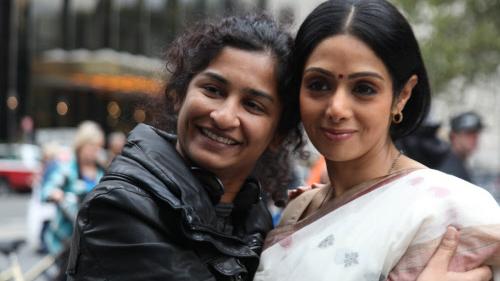
Gauri Shinde’s English Vinglish, a great box office success marked the comeback of Sridevi and her first under a woman director. English Vinglish subverts the mother figure we have seen in umpteen films with Mother India as the icon of all celluloid mothers. Shashi Godbole, the wife of Satish Godbole (Adil Hussain), does not really represent either the iconic mother we met in many Hindi films or the modern mother in contemporary Bollywood films. She redefines the concept of wifehood and motherhood differently though apparently, she comes across as the ideal image of motherhood.

The most amazing is that though Shashi is a successful entrepreneur who runs her own business in preparing, making and distributing laddus to a growing clientele, her corporate husband Satish Godbole and snobbish daughter Sapna neither recognise her professional identity nor invest her with any status for her efficiency in both business and household responsibilities. The script leaves no stone unturned to belittle Shashi Godbole’s thriving business into a non-business. The constant nit-picking is simple – Shashi cannot speak English fluently.
Shashi herself is not aware of her true worth as a successful wife, mother and working woman. She realizes this only when her English teacher in her Manhattan class says that she is an “entrepreneur” and explains what the word means. But when she tells this to her husband over the phone, he dismisses this with an amused smile and repeats the word “entrepreneur” in a derogatory way. Shashi’s face falls but she does not complain. He mocks her by pronouncing the word entrepreneur with a foreign accent.
She does not express her anger, hurt and humiliation even once during the entire film. This is an example of how deeply Indian women have internalised feelings of being “less” than those who humiliate them. Though her face falls every time she is ridiculed or belittled, one wonders why she does not have the gumption to express her anger and hurt.
She has no decision-making powers in her own home, financial or otherwise. In one scene, she expresses a wish to take the little Sagar along to the US with her as he does not want to be away from his mother. Satish puts his foot down and says “No” and that is that. Later, in New York, when her husband finds his wife is behaving differently, is absent minded, lost in her own thoughts, he is angry. Her decision to join the English tuition class is somewhat constrained when she learns that the fees are $400 for the entire course. She fishes into her purse and brings out the sum she has made from her laddu enterprise. This implies that she is not given enough money by her husband to wade through sudden expenses.
Shashi Godbole is a classic example of how the Indian woman, never mind her status as a self-respecting earning woman, is not empowered either by the fact that she is financially independent or that she is a very efficient wife, daughter-in-law and mother.
The Great Indian Kitchen (2021)
This film in Malayalam directed by Jeo Baby comes like a stinging double-slap – one on the supporting characters who believe that conventional practices are slotted exclusively for women in the family and the other, on the audience, a major slice of which actually believes that a married woman’s rightful place is in the kitchen. It is not limited to financial freedom but on the restrictions placed on her by her husband and father-in-law, caging her, a trained dancer, in a prison cell called “kitchen” and torturing her without ever using physical violence.
When she applies for the job of a dance teacher, her father-in-law says “we discussed it, didn’t we” though no such a discussion ever took place. Her husband agrees unquestionably and her father-in-law tells her that her mother-in-law is a post-graduate but she never took up a job and that is why the children are so well brought up! Really? With an ill-mannered school teacher for a son who demanded a new car as part of the dowry and a very selfish, pregnant daughter who summons her mother to the US instead of appointing an ayah? The director has kept the characters nameless as a sharp pointer to the universality of issues shown as happening to most wives everywhere in Kerala.
Sharthopor (2025)
This Bengali film is directed by the debutant Annapurna Basu. The film deals with Aparna (Koel Mullick),a married woman’s lack of financial independence though apparently, she leads a contented life with husband Deborshi (Indrajit Chakraborty), little daughter and mother-in-
law (Papia Sen). She has a close bonding with her much older brother Saurabh (Koushik Sen) and his wife (Saoli).
Aparna realises that she lacks financial independence by accident. During a sudden emergency, she withdraws a heavy sum to help someone. It is from a matured FD held in joint names with her husband. But as she cannot get him on the phone, she could not inform him. When she tells him, all hell breaks loose. With a sense of deep shock, Aparna realises that she has absolutely no right to withdraw money without her husband’s permission because it is his earnings, not hers. Aparna realizes that the right and power to take any financial decisions independently does not exist in her life.
This sense of uncertainty doubles when during a visit to her brother’s family, she learns that a part of the house is being sold away to a promoter at a high price to start a home-stay-cum-resort. Aparna, who deeply cherishes the sweet memories of her childhood spent with her dear brother and parents is loathe to part with what, she believes, is partly her inheritance too.
When her brother says that she is married and living happily with her husband, Aparna points out that she lives there because she is married, but the house does not belong to her. When her brother adamantly refuses to give her a share of the house, Aparna decides to take her claim to court. Aparna fails to convince everyone, including her husband, that money is not the issue at all. She is emotionally attached to the nostalgia the house carries for her and the monetary value of the house, holds no meaning for her except that it is hers by right.
Haq (2025)
Following right on the heels of Sharthopor comes the Bollywood mainstream film Haq (Right) directed by Suparn Verma. It updates and presents in subtle Bollywood style, the resurrected real life case of Shah Bano whose fight for her financial rights post-Talaq by her husband created a new law for divorced women in India. The lavishly mounted film with big stars does not dent the seriousness of the subject enriched by superb performances by the acting cast.
Mohd. Ahmad Khan v. Shah Bano Begum [1985], referred to as the Shah Bano case, was a controversial maintenance lawsuit in India, in which the Supreme Court delivered a judgment in favour of providing maintenance to an aggrieved divorced Muslim woman.
The Shah Bano case was a pivotal legal matter with substantial consequences for the rights of Muslim women. It raised important questions about the rights of women. This case centred on Shah Bano’s request for financial support from her husband under Section 125 of the Code of Criminal Procedure. The case drew attention to the absence of clear rules regarding financial support in Muslim personal law.
This case also underscored the clash between personal laws and the concept of a uniform civil code, which aims to have a common set of rules governing personal matters, irrespective of one’s religious beliefs. The case sparked a nationwide discussion about women’s rights and gender equality. It also prompted conversations about the necessity to address these inequalities and protect the rights of Muslim women.
Financial independence of Indian women is a subject producers, directors and even actors shy away from. Firstly, because it is a topic that smacks of severe patriarchy, never mind if the woman is working at a job or is a housewife. Secondly, because its box office returns are uncertain as it is something the audience might not warm up to. Thirdly, a small percentage of women actually believe in the lack of financial independence, specially the married ones. Some of them even take pride in remaining housewives and mothers and even if they worked before marriage, they have no regrets in quitting their jobs to settle down to ‘happy domesticity’. These films are a pointer not necessarily to be internalized by women. But these are powerful attempts to show that cinema is multi-layered and multi-functional. Happy viewing.


