

The Under-45 Club is hijacking Bollywood’s Top 10: New-Age younger Directors are breaking the blockbuster algorithm, and the old guard is feeling the heat 45 : Bollywood News
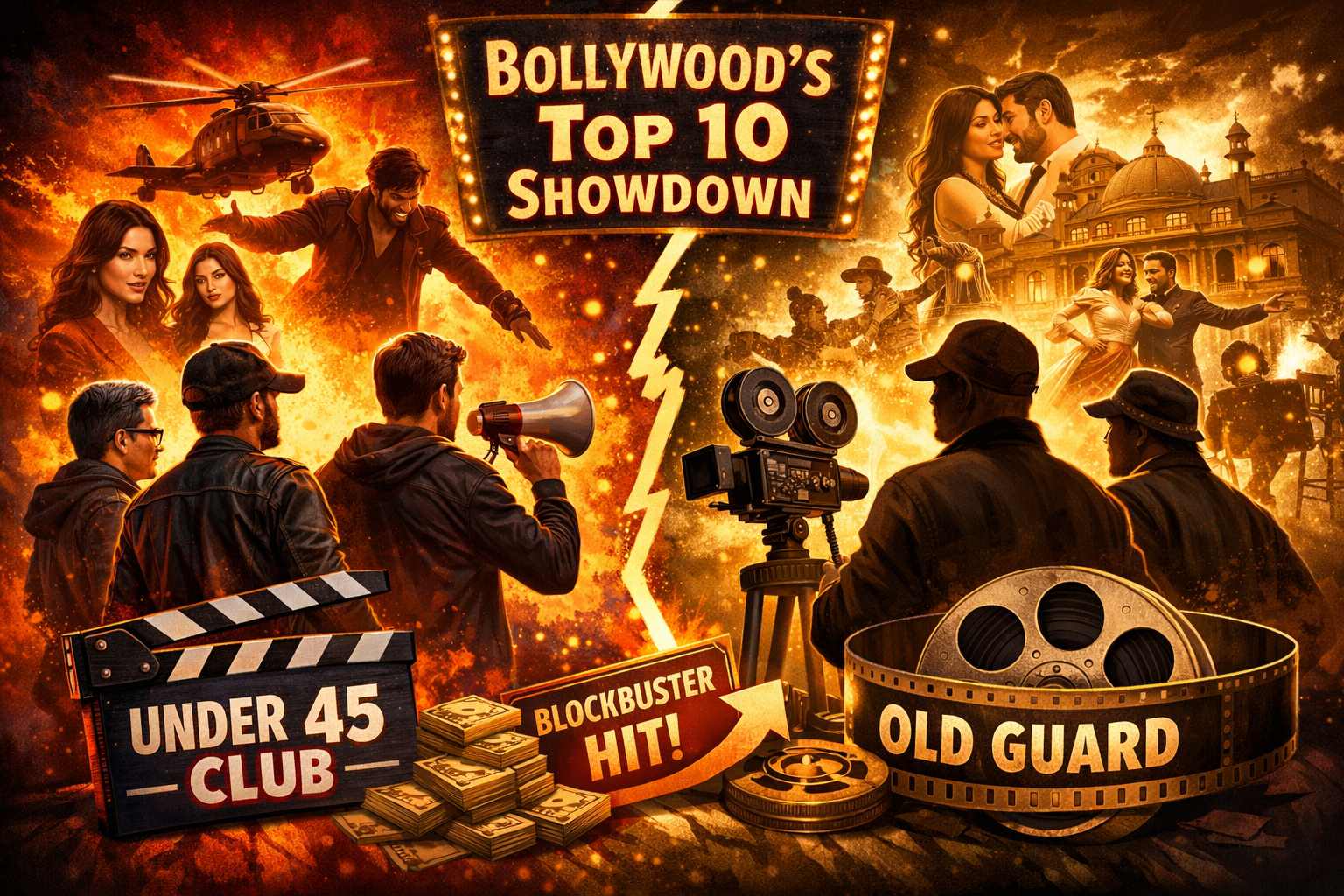
Hindi cinema is at an inflection point, and the most telling evidence isn’t a trade quote or a Twitter trend. It’s the all-time blockbuster table itself. When one looks at the directors behind the All Time Top 10 Bollywood movies list, a pattern emerges with surprising clarity: the biggest commercial event films of this era are increasingly being driven by a newer generation of filmmakers, many of whom are hitting their career-defining jackpots in their late 30s and early to mid 40s. That doesn’t automatically make it an old vs new battle, but it does make one thing undeniable: the power centre is shifting from star-only narratives to director-led big-screen engineering.

The Under-45 Club is hijacking Bollywood’s Top 10: New-Age younger Directors are breaking the blockbuster algorithm, and the old guard is feeling the heat
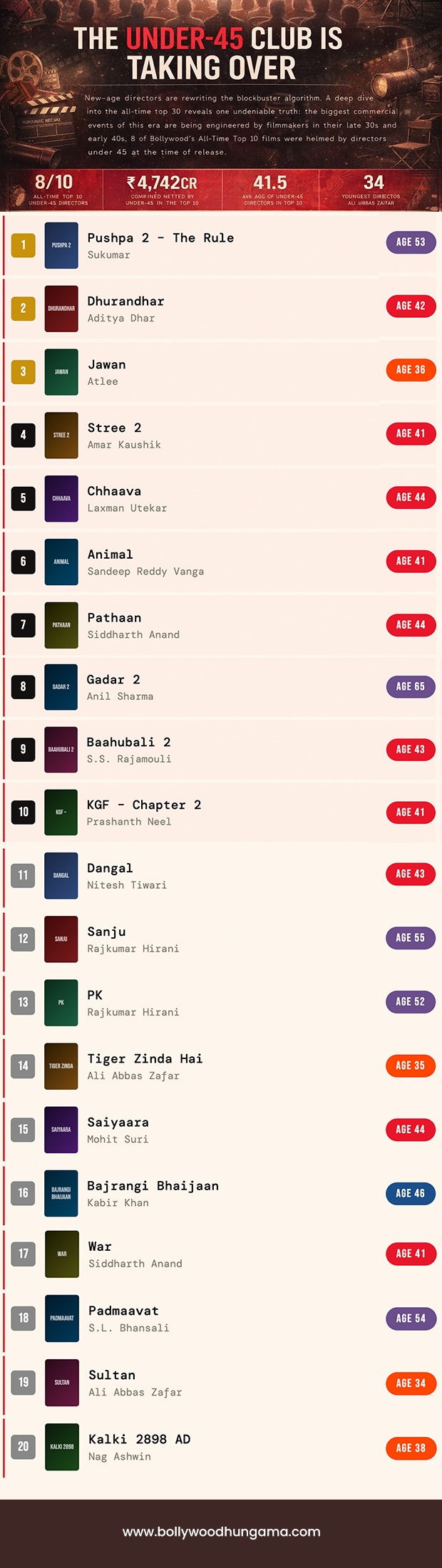
Start with the names that keep repeating in the blockbuster conversation. Aditya Dhar is now 42, and what stands out is how early he announced himself as a theatrical force. He was 36 when he made Uri, and within a few years, he is being discussed in the same breath as the industry’s biggest event makers. Atlee delivered Jawan’s historic impact at 37. Sandeep Reddy Vanga was 37 when Kabir Singh hit the screens and 42 when Animal became a phenomenon. Amar Kaushik, 42, is right up there on Top 10 Bollywood list through Stree 2, a reminder that mass today doesn’t only mean action and macho heroism; it can also mean a genre universe with strong repeat value, humour, fear, music, and pop culture memory.
In fact, this prime-age blockbuster trend isn’t limited to just the newest names. Even within the broader Top 10 ecosystem, several directors delivered their biggest crowd-pullers at a similar age band:
Ayan Mukerji (Brahmastra – Part One: Shiva): 39 years
Mohit Suri (Saiyaara): 45 years
Ali Abbas Zafar (Sultan): 34 years
Om Raut (Tanhaji): 38 years
Nitesh Tiwari (Dangal): 43 years
Siddharth Anand (War): 41 years
These ages matter not because youth is a virtue, but because they show how the modern marketplace is rewarding directors who can scale up quickly, read the audience sharply, and package an unmistakable theatrical promise. It’s not just about making a good film. It’s about making a film that feels like a must-watch in a theatre, a film that people don’t postpone, don’t wait for OTT for, and don’t consume quietly. The new-wave directors have become specialists in manufacturing urgency. The kind of urgency that converts into massive openings, high footfalls, and loud word of mouth.
Now contrast this with the directors who are conspicuously absent from the Top 10 table. Names that have shaped mainstream Hindi cinema for years: Kabir Khan, Ali Abbas Zafar, Sanjay Leela Bhansali, Rohit Shetty, Karan Johar, Sooraj Barjatya, Anees Bazmee etc. It would be lazy and unfair to interpret their absence as irrelevance. The more accurate reading is this: the definition of a Top 10 all-time blockbuster has changed. The bar is no longer successful or even a super hit. The bar is a cultural event plus a nationwide scale that translates into repeat consumption as well as theatre first must watch. That’s a narrower lane than it sounds, and it’s become brutally competitive.
The age comparison adds an interesting layer, and again, it doesn’t need to be disrespectful to be honest. Today, Karan Johar is 53. Rohit Shetty is 51. Siddharth Anand, who is actually present in the Top 10 Bollywood list with Pathaan is 47, placing him in a middle zone: not the old guard, not the new breakout kid either, but a prime example of a filmmaker who has understood how to build a modern scale action spectacle for theatres. Sanjay Leela Bhansali is 62. Rajkumar Hirani is 63. Anees Bazmee is 63. On paper, that looks like a generational divide. In reality, it’s an adaptation divide.
Because here’s the nuance that makes this discussion mature: Rajkumar Hirani is not out. He is literally in the Top 10 Bollywood list twice with Sanju and PK (if we remove the Hindi dubbed movies). That alone should stop anyone from turning this into a simplistic veterans can’t deliver narrative. However, once the frame widens to the larger Hindi box office conversation, the one influenced by pan-India performance and dubbed cross-market dominance, the leadership leans even more towards directors shaping the biggest, widest, loudest theatrical events. The board becomes more crowded, the competition becomes national, and the space for traditional Hindi studio comfort zones shrinks.
So why are the newer names landing all-time blockbusters time and time again? Because they are building films as products of the current attention economy. Their stories are high-concept and instantly legible. Their pacing is engineered for the first weekend as much as for the second. Their moments are designed to travel on reels, in crowd videos, in dialogues, in music hooks, in entry scenes. Their cinema is not smaller or simpler; it’s simply more ruthless about delivering a theatrical payoff every ten minutes.
Meanwhile, several legacy filmmakers are still operating with an older assumption: that goodwill, brand, and star power will naturally convert into a monster opening and sustained run. In today’s market, goodwill is still valuable, but it’s no longer a guarantee of Top 10 outcomes. The audience now makes its decision faster and often based on whether the film looks like an event. That shift hurts even good films that don’t feel urgent. It hurts storytelling that takes time to bloom. It hurts projects that are sold on prestige instead of adrenaline.
Will the old guard give tough competition to the new-age directors? Yes, and they may do it sooner than people expect. Not by chasing youth, but by adopting the new era’s discipline. The veterans who win next will be the ones who preserve their signature strengths, emotional depth, craft authority, music storytelling, casting instinct, tonal maturity while tightening their packaging for the theatrical race. The comeback formula isn’t complicated; it’s just demanding sharper writing, stronger pacing, bolder scale where needed, and one crystal clear audience promise.
The real headline isn’t old directors vs new directors. The real headline is: the director has become the primary star of the box office era again and the all-time tables are now rewarding filmmakers who can combine conviction with contemporary execution. The next two years will reveal which veterans respond like legacy brands and which respond like challengers.
More Pages: Dhurandhar The Revenge Box Office Collection , Dhurandhar The Revenge Movie Review
BOLLYWOOD NEWS – LIVE UPDATES
Catch us for latest Bollywood News, New Bollywood Movies update, Box office collection, New Movies Release , Bollywood News Hindi, Entertainment News, Bollywood Live News Today & Upcoming Movies 2026 and stay updated with latest hindi movies only on Bollywood Hungama.


