
10 Fantasy Movies From the 20th Century That Are Actually Perfect
Throughout the entirety of the 20th century, starting with cinema’s infancy as a storytelling medium during the first couple of decades of the century and moving on to the blockbuster days of the ’80s and ’90s, the world received several of the greatest fantasy movies ever made. No matter what subgenre they belong to, the best fantasy films of these 100 years are the peak of what the genre has to offer on the big screen.
But while there can be several fantasy gems that, though flawed, can still be counted among the best in the genre’s history, there are only a handful of fantasy masterpieces that can reasonably be said to be truly perfect. Regardless of whether they’re more dramatic or comedic, high fantasy or low fantasy, or more artistically-minded or more suited to mainstream tastes, these ten 20th-century fantasy films are about as close as the genre has ever come to genuine flawlessness.
‘The Wizard of Oz’ (1939)

In the history of not just cinematic fantasy, but Hollywood cinema in general, there’s a before and an after The Wizard of Oz. Victor Fleming‘s magnum opus (which moved through the hands of another three or four directors before and after landing in Fleming’s) is one of the most universally loved fantasy movies of all time, a magical family film with some of the catchiest tunes, brightest colors, and most endearing characters of any Hollywood classic.
From the film’s revolutionary use of three-strip Technicolor to the tremendous impact that it’s had on pop culture over the years—both as a mainstream classic and as a cult classic embraced by various niche groups—, it’s still a must-see for families around the world 87 years after its release. Very few Golden-Age Hollywood movies are this remarkably timeless.
‘The Princess Bride’ (1987)

Directed by Rob Reiner and written by William Goldman, based on Goldman’s book of the same name, The Princess Bride is one of the most universally beloved cult classics of all time. Told through the brilliantly entertaining framing device of a man telling his bedridden grandson a bedtime story, the tale of Westley and Princess Buttercup is an old-fashioned hero’s journey adventure that has aged like fine wine.
What makes The Princess Bride so perfect is that there’s something here for virtually anyone and everyone to enjoy, and each one of those elements is executed wonderfully. There’s swashbuckling action, swoon-worthy romance, thrilling character arcs, a rousing revenge story, and an emotionally cathartic conclusion. The Princess Bride is an irresistibly effective celebration of the art of storytelling itself.
‘Monty Python and the Holy Grail’ (1975)

Rarely has the Earth been graced with groups of people as hilarious as the British comedy troupe Monty Python. The group made three narrative films together, and the most famous and iconic of all is undoubtedly Monty Python and the Holy Grail. Simultaneously a love letter to Arthurian legend and a satirical parody of it (and of the fantasy genre as a whole), it’s far and away one of the funniest movies ever made.
What follows one of the best fantasy movie opening scenes ever is a parade of absurdist jokes, running gags, sketches, musical numbers, and non-sequiturs that make it impossible to contain one’s laughter. The movie was made on a ridiculously low budget, and that only makes its creativity and originality shine through even more. Rarely has a group of people been this committed to making a fantasy film, and what came out of it is still perfect over 50 years later.
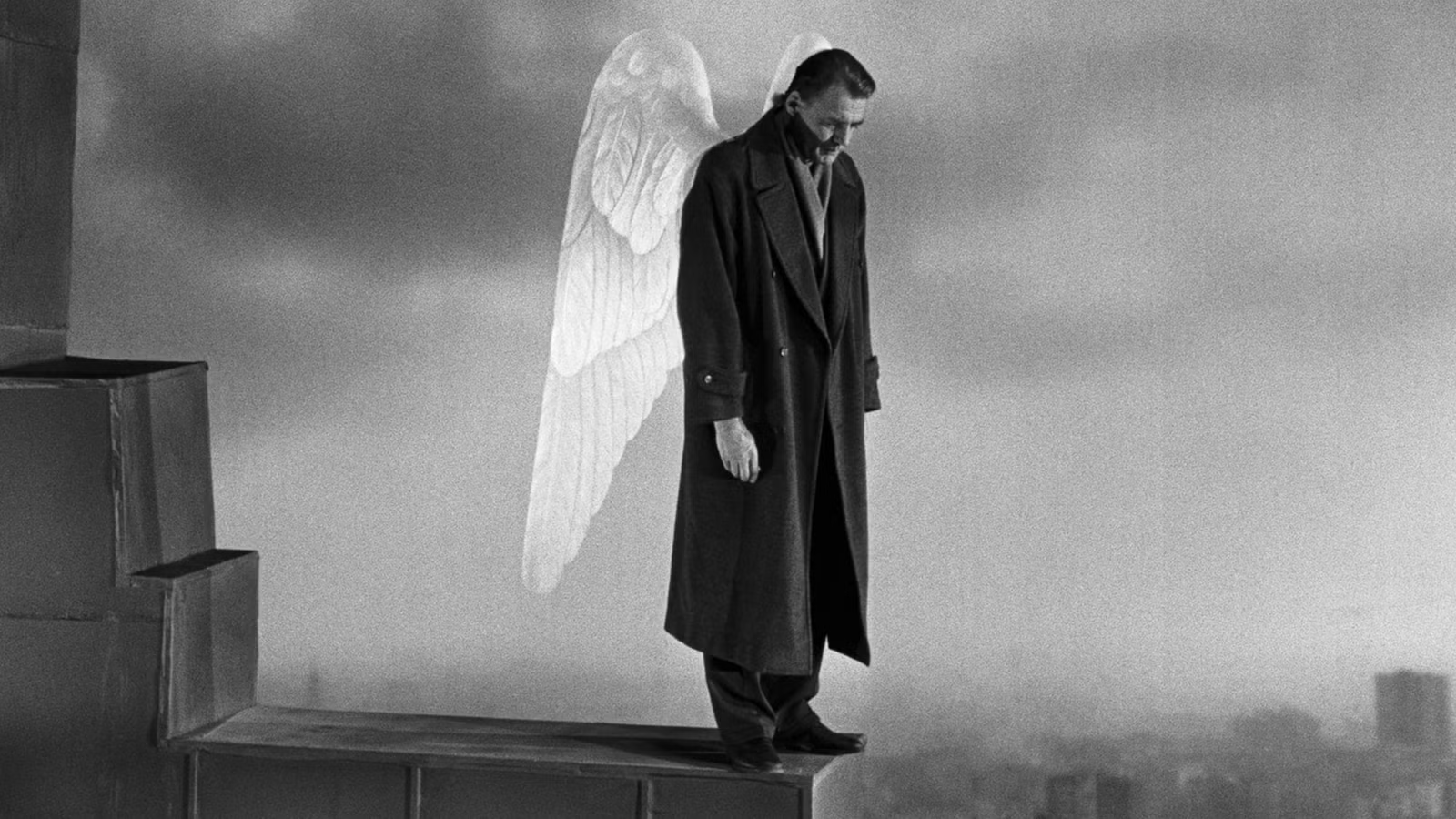
‘Wings of Desire’ (1987)

Wim Wenders is one of the most celebrated German filmmakers in history, and Wings of Desire is one of his most highly acclaimed films. It’s also one of the highest-rated fantasy movies on Letterboxd, and for good reason. It’s the slow-burning tale of an angel who falls in love with a human woman, and though it’s definitely not a film made for those unaccustomed to the usual rhythm of an arthouse fantasy film, it’s still a must-see for all those who love the genre.
It’s one of the most beautiful, life-affirming, and poetic films ever made. Through its gorgeous imagery and richly symbolic story, Wings of Desire celebrates the beauty and richness of the human experience in ways that are impossible to resist, even for the most cynical of viewers. As enchanting as it is poignant, this Wenders masterpiece is one of the greatest films that have ever come out of Germany.
‘The Seventh Seal’ (1957)

Ingmar Bergman, widely recognized as both the greatest Swedish filmmaker in history and one of the most influential European filmmakers of all time, made many an iconic masterpiece over the course of his career. Perhaps the most celebrated of all, The Seventh Seal is an arthouse fantasy classic like no other, one of the most perfect fantasy movies of the 20th century.
Bergman was well-known for how depressing yet oddly life-affirming his work was, and The Seventh Seal is no exception. Exploring the dread of God’s silence and the search for meaning in a world where death is the only certainty, it’s one of Bergman’s most stylistically daring and narratively ambitious films. Visually perfect, perfectly written, and perfectly directed, The Seventh Seal is some of the best work of one of the Seventh Art’s most important voices.
‘Princess Mononoke’ (1997)
For decades, Studio Ghibli has been making several fantasy movies so good you can’t stop watching them, particularly when it comes to the filmography of the studio’s poster boy, the great Hayao Miyazaki. Case in point: Princess Mononoke, heavily inspired by Japanese history and Shinto folklore, one of the most beautiful and thought-provoking animated movies in history.
Princess Mononoke explores the often destructive clashes between industrialization and nature in uniquely Miyazaki-esque ways, with a blend of CGI to enhance the primarily hand-drawn animation (a first for Miyazaki at the time) that has aged flawlessly. The writing, visuals, music, and voice acting are all utterly beyond reproach, and they’ve ensured that Princess Mononoke remains one of the most timeless masterpieces in the history of animated cinema.
‘The Empire Strikes Back’ (1980)

Widely recognized as the greatest Star Wars film of the bunch, The Empire Strikes Back is one of the greatest movie masterpieces of the last 50 years. This space opera is as much of a fantasy movie as it is science fiction (a blend typically known as science-fantasy), and never has this mixture of genres worked more effectively than in what is now retroactively known as the fifth chapter of the Skywalker Saga.
The Empire Strikes Back is not only the peak of Star Wars media, but the peak of genre filmmaking as a whole. Its pacing and sense of adventure are perfect, its expansion of the original film’s themes and world is still exciting all these many years later, and its technical qualities are all absolutely faultless. Featuring some of the most iconic scenes in movie history and what’s perhaps the most famous plot twist in all of cinema, it’s a classic fully worthy of its genre-defining legacy.
‘Macario’ (1960)

Back in Mexico, it’s a tradition to watch Roberto Gavaldón‘s Macario during the Day of the Dead season. Indeed, you’d be hard-pressed to find a better film about death and the human condition from anywhere in the world. This tale about a poor and hungry peasant who wishes to have a good meal for All Saints’ Day, and then encounters the Devil, God, and the Grim Reaper, deserves to be remembered as a far bigger classic outside of its home country.
It’s one of those perfect dark fantasy movies that nobody seems to remember anymore, a beautiful story that explores social, philosophical, and spiritual themes in ways that anyone—no matter where they’re from—should be able to appreciate. Shot in gorgeous black-and-white and starring an incredible Ignacio López Tarso, this magical realism gem is the best that Latin American cinema as a whole has to offer.
‘Fanny and Alexander’ (1982)
.jpg?q=49&fit=crop&w=500&dpr=2)
There’s a reason why Ingmar Bergman’s Fanny and Alexander was one of famed Chicago critic Roger Ebert‘s favorite fantasy movies of all time. Clocking in at three hours in its theatrical cut and a whopping five hours in its TV miniseries version, it’s definitely not ideal for impatient cinephiles. On the other hand, those willing to sit down with such a long story of family, religion, and the power of imagination and stories will be treated to one of Bergman’s best.
Fanny and Alexander‘s fantastical elements are relatively subtle, but they lend it a beautifully magical atmosphere that anchors the viewpoint of its child protagonists perfectly. Bergman intended it to be his final film, but though that didn’t end up being the case, it still feels like a deeply moving swan song to cap off the vision of one of cinema’s biggest artists. It’s not just fantasy fans who should consider it essential viewing, but cinephiles as a whole.
‘It’s a Wonderful Life’ (1946)

Frank Capra was always one of Golden-Age Hollywood’s biggest visionaries, a director never afraid to push the envelope and dance around the limitations of the censorial Hays Code. This bold nature eventually led to the first film that Capra made after serving as a Colonel during World War II: It’s a Wonderful Life, starring the legendary James Stewart (who also reached the rank of Colonel during the war).
It’s a Wonderful Life is permeated with precisely the kind of melancholy tone that you’d expect from artists freshly returned from a world-altering military conflict, and it’s probably no coincidence that it deals with themes of suicide and men’s mental health. But as poignant as it can be, this far-ahead-of-its-time Christmas classic is also one of the best crowd-pleasing fantasy movies ever made, leading to one of the most beautifully hopeful and life-affirming endings in movie history. Capra made many exceptional movies over the course of his career, but none more genuinely perfect than this one.

