
10 Greatest Ultraviolent Action Movies of All Time
We go to the movies to escape reality. No matter the genre, movies are meant to be a departure from reality because sometimes they go further than our reality allows. When it comes to action flicks or thrillers, the adrenaline rush gets our hearts pounding as the scenes go beyond our wildest imagination. But what if there is an intensity beyond that? That’s where ultraviolet films come in. Just when you thought it couldn’t get any bloodier or gorier, it does.
Pulling from an array of genres and themes, the ten films on this list are the greatest ultraviolet action films of all time. From pop culture classics to underrated thrillers, these films sparingly give you a moment to catch your breath, and that’s OK, since that’s their mission! These movies are not for the faint of heart, but if you can handle them, they are some wonderful cinematic masterpieces.
10
‘A Clockwork Orange’ (1971)

You can’t have a list about the greatest ultraviolent action films without the film about ultraviolence! Though the Stanley Kubrick film may not be traditionally action-centric, its themes and graphic nature propel it forward. Based on Anthony Burgess‘ 1962 novel, A Clockwork Orange follows Alex DeLarge (Malcolm McDowell), a charismatic delinquent in a dystopian future who leads a gang of “droogs” in brutal acts of violence. After being imprisoned for murder, he undergoes state-sanctioned aversion therapy that strips him of his free will to choose between good and evil.
A Clockwork Orange remains a pertinent film for its themes. The narrative explores whether violent youth are a product of a broken society and whether individuals can naturally mature past destructive impulses. It skewers free will, morality, and state control through Kubrick’s groundbreaking cinematic style and incredible production design. The film warns how governments and modern psychology can weaponize behavior modification to turn humans into complicit operatives. By pairing extreme acts of violence with vibrant and cheerful tracks, it creates a sickeningly surreal dissonance. By the time Alex is tortured, the audience is then forced to decide if the torture itself is an act of ultra-violence.
9
‘Brawl in Cell Block 99’ (2017)

If you were expecting to see Vince Vaughn bring comedy to Brawl in Cell Block 99, steer clear! Directed by S. Craig Zahler, the neo-noir action thriller tells the story of Bradley Thomas (Vaughn), a former boxer-turned-auto mechanic sent to prison. While inside, shadowy criminals kidnap his pregnant wife, Lauren (Jennifer Carpenter), and force him to brutally fight his way into a maximum-security facility to assassinate a specific inmate.
A ruthless and unrelenting thriller, Brawl in Cell Block 99 blends a blue-collar tragedy with visceral, uncompromising genre thrills. It subverts expectations from the start, and paired with Zahler’s uniquely deliberate, pulp-exploitation style, the film goes to great lengths to craft a revenge drama. The brutal descent into the prison system is intense. In the absence of a traditional score during the fights, the violence feels raw, heavy, and uncomfortably realistic, evoking a grimy, 1970s grindhouse exploitation vibe with tactile practical effects that make every punch visceral and bone-crushing.
8
‘Green Room’ (2015)

The blend of horror and thriller often leads to some extraordinary action-packed films; such is the case for the underrated gem Green Room. Directed by Jeremy Saulnier, the intense horror film tells the tale of a struggling punk rock band, The Ain’t Rights, that gets trapped in the backstage green room of a remote venue run by neo-Nazi skinheads, led by Darcy (Patrick Stewart). After accidentally witnessing a murder, they find themselves in a brutal fight for survival.
Green Room is filled to the brim with raw, fast-paced, and jarringly realistic violence. With a stellar cast, featuring Anton Yelchin, Imogen Poots, Alia Shawkat, Joe Cole, and Callum Turner, the film is a claustrophobic survival thriller that becomes an enduring nightmare. Unlike standard horror movies, the suspense is more immediate, and thus, the violence feels sudden, brutal, and physically heavy: wounds from box cutters, machetes, and attack dogs are messy, painful, and chaotic. Out of acts of desperation, the witnesses make flawed choices under extreme panic, meaning anyone can die at any moment regardless of heroism.
7
‘Martyrs’ (2008)

Brutal is an understatement when describing the 2008 French film Martyrs. Written and directed by Pascal Laugier, the film follows a traumatized young woman named Lucie Jurin (Mylène Jamponoï) seeking revenge against the people who kidnapped and tortured her as a child. Aided by her friend Anna Assaour (Morjana Alaoui), the film shifts from a bloody home-invasion revenge story into a harrowing conspiracy.
Martyrs captures the philosophical concept that intense, unendurable pain can strip away human identity and offer a direct “witness” to the mystery of death. A notable film in the New French Extremity movement, it uses graphic violence and unrelenting despair to force the audience to confront the physical and psychological limits of endurance. The visceral torture scenes serve as a commentary on how society and horror fans consume on-screen brutality, forcing the audience to sit through uncomfortably real-feeling consequences rather than sanitized action. Martyrs pushed the boundaries for French cinema, becoming an emotionally draining experience unlike any other.
6
‘Natural Born Killers’ (1994)

Though you may not consider it a traditional action flick, Natural Born Killers remains a relentless, graphic, and stylized thriller that flourishes through explicit intensity. Directed by Oliver Stone, the iconic 1994 film follows Mickey and Mallory Knox (Woody Harrelson and Juliette Lewis), two traumatized lovers who escape abusive childhoods and go on a massive, cross-country killing spree. Instead of damnation, they become terrifying pop-culture celebrities through irresponsible media sensationalism, led by sleazy TV reporter Wayne Gale (Robert Downey Jr.).
A monstrous dark satire on 24-hour news cycle consumption, Natural Born Killers is a Stone masterpiece that doesn’t skimp on a stylized barrage of bloodshed, murder, and chaos. From a modern perspective, it’s a prophetic film on media sensationalism and society’s morbid obsession with celebrity violence. Stone directs the film as a visual assault, mixing black-and-white and color footage, different film stocks, animation, and rapid-fire editing to mirror the characters’ fractured psychology. The body count is high, with dozens of casual victims and law enforcement officers dead, all told through aggressive and purposefully uncomfortable hyper-violence.
5
‘The Wild Bunch’ (1969)

And now it’s time to journey to the Western Wild with the 1969 epic, The Wild Bunch. Directed by Sam Peckinpah, the revisionist Western follows an aging gang of outlaws, led by Pike Bishop (William Holden), on the Texas-Mexico border in 1913. Trying to survive as the traditional American West vanishes and modern technology takes over, they pull off a final robbery, stealing a shipment of U.S. Army weapons to sell to a corrupt Mexican general named Mapache (Emilio Fernández). They then get chased by bounty hunters, led by Deke Thornton (Robert Ryan)—Pike’s former partner— and tangle with the brutal Mexican warlord.
The Wild Bunch portrays the obsolescence of the classic Western outlaw, overrun by automobiles, machine guns, and organized civilization, by using violence to shatter the image of clean-cut cowboys. It pushed the Western action film to new heights; gone were traditional norms as graphic, rapid-fire, slow-motion bloodshed introduced cowboys as flawed anti-heroes. Set against the backdrop of the Mexican Revolution, The Wild Bunch portrays a frontier era rapidly becoming obsolete, where the blurred line of morality between lawmen, led by a corrupt bounty hunter, and outlaws is driven by survival, ego, and bloodlust.
4
‘The Raid’ (2011)

When it comes to extraordinary action films, look no further than the Indonesian masterpiece, The Raid. Directed by Gareth Evans, the martial arts thriller follows an elite tactical SWAT team, led by Sergeant Jaka (Joe Taslim) and Lieutenant Wahyu (Pierre Gruno), that infiltrates a rundown apartment block in Jakarta to capture a ruthless drug lord, Tama (Ray Sahetapy). Joined by rookie cop Rama (Iko Uwais), the team becomes trapped on the upper floors when their cover is blown.
Known for its extensive use of Pencak Silat, improvised weapons, and sheer endurance to survive the night, The Raid is an unrelenting thriller that strips away all exposition in favor of pure, visceral action. The tight, confined high-rise moves from a haven to a lethal puzzle, where traps are ever-present. With the police unit unsure of what may come next, the audience is left on the edge of their seats. Evans uses expert pacing and strategic wide-angle camerawork to ensure the film’s focus is on the brutality. No shaky-cams here! Every punch and blow lands with intense clarity, showcasing the fast, traditional Indonesian martial arts with incredible precision.
3
‘Kill Bill Vol. 1’ (2003)

Quentin Tarantino‘s game-changing Kill Bill Vol. 1 follows a pregnant assassin known as The Bride (Uma Thurman), who survives a brutal wedding-day massacre orchestrated by her ex-lover Bill (David Carradine) and the Deadly Assassination Squad. After waking from a four-year coma, she launches a bloody crusade for revenge, crossing off two former members from her death list—Vernita Green (Vivica A. Fox) and O-Ren Ishii (Lucy Liu).
A celebrated action thriller, the high-octane film blends Hong Kong martial arts, Japanese samurai traditions, spaghetti westerns, and anime into a stylish revenge epic with a pretty bloody result. Anchored by Thurman’s career-defining performance, Kill Bill Vol. 1 transforms extreme gore into high art. The action isn’t just for shock; every choreographed scene moves like a dance. Fight choreographer Yuen Woo-ping made what could have been overwhelming sequences with the odds against him look like a work of fine art. The Crazy 88 fight remains a classic.
2
‘Battle Royale’ (2000)

Coming straight from Japan is one of the most violent dystopian action thrillers of all time, Battle Royale. The film, directed by Kinji Fukasaku from a screenplay by Kenta Fukasaku, based on the novel by Koushun Takami, follows a random junior high school class forced by a totalitarian Japanese government into a 3-day fight to the death on a deserted island. Students wake up on a remote island wearing explosive collars, instructed by their former teacher Kitano (Beat Takeshi) to kill each other until only one remains after three days.
Battle Royale had an immense impact on pop culture, influencing many future, albeit more sanitized, stories like The Hunger Games and Squid Game. Fukasaku balances exploitation-level violence with a surprisingly poetic core. The fictional “Millennium Education Act” reflects adult anxieties over youth delinquency and societal breakdown, highlighting the cruelty imposed by the adult world on the younger generation. Fukasaku shows no hesitation in depicting teenagers dying graphically, using an on-screen scoreboard tallying the dead to emphasize the grim reality of the game. From stabbings to shootings, explosions to poisonings, nothing is off the table.
1
‘I Saw the Devil’ (2010)

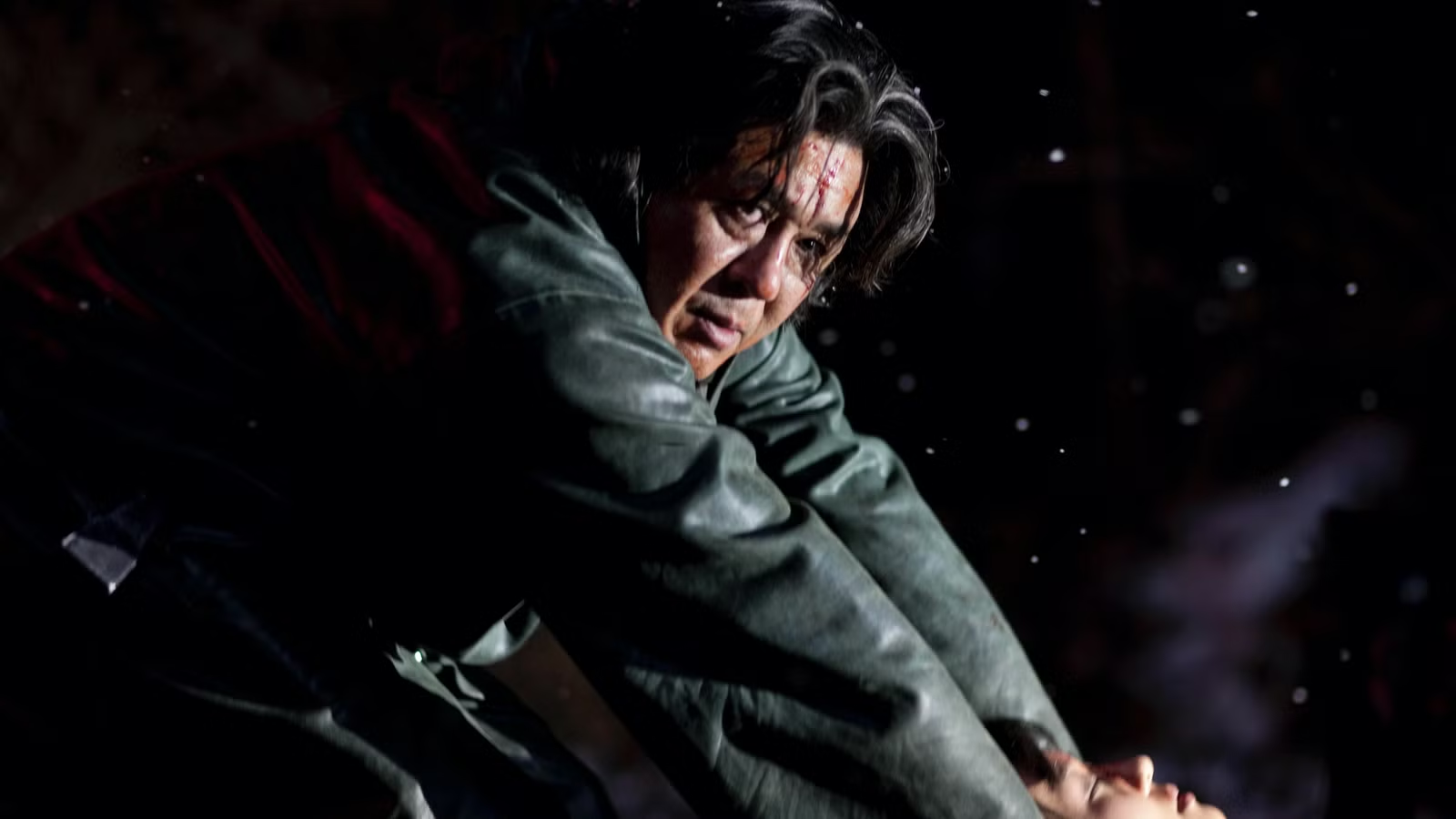
When it comes to ultraviolent action thrillers, it doesn’t get better than I Saw the Devil. The South Korean film directed by Kim Jee-woon and written by Park Hoon-jung follows elite NIS agent Kim Soo-hyun (Lee Byung-hun), whose pregnant fiancée, Jang Joo-yeon (Oh San-ha), is brutally murdered by a sadistic serial killer named Jang Kyung-chul (Choi Min-sik). Instead of turning him in to the police or killing the murderer straight away, Soo-hyun implants a GPS tracker in Kyung-chul and embarks on a sadistic game of catch-and-release to torture him, inflicting severe physical and psychological pain.
I Saw the Devil explores how absolute hatred and the pursuit of extreme retribution corrupt the hunter, turning the protagonist into a morally empty monster like the man he preys on. Like other films on this list, it trades the instant gratification of a quick kill for a long-running psychological mind game, turning the traditional revenge thriller upside down. With striking cinematography, I Saw the Devil is a sleek-looking film that forces viewers to question where the true evil lies: when the red of blood enters the frame against the stark, chilling colors, it viscerally resonates.


