
7 Movie Masterpieces That Saved Dying Genres
If you look at the theaters or streaming services and bemoan that all those movies practically belong to one of ten genres, you’re not wrong. Filmmaking and Hollywood are essentially business machines, and they will resort to tried and tested formulas to turn a profit. Nevertheless, sometimes audiences can find new, groundbreaking movies that revive forgotten or dying genres. They were once formidable genres so it makes sense for filmmakers to spark new interest in them and bring more diversity to the new releases.
Throughout the years, there have been movies that completely changed the conversation. With modern filmmaking, the films on this list reminded audiences why their genres became popular in the first place while proving to studios that there was still money to be made. Their success expanded beyond the movies themselves and their sequels, but they sparked waves of imitators and inspired new franchises. Call them movie defibrillators because these great movies successfully brought these dying genres to life.
‘Taken’ (2008)

By the late 2000s, Hollywood action movies had become increasingly dominated by massive budgets and CGI-heavy spectacles, like The Bourne Ultimatum and Live Free or Die Hard. Mid-budget action thrillers that relied on small-scale stakes were becoming increasingly uncommon in theaters as they’re relegated to DVDs. Just a few years before, there were modestly budgeted movies like Phone Booth or Deja Vu that were respectable but didn’t become big hits, so studios focused their resources elsewhere.
When Taken became a runaway hit in 2008, it changed the landscape. It showed that when it has the right ingredients like strong pacing, memorable characters and solid action, audiences want to see this kind of movie. It transformed Liam Neeson into one of the industry’s most reliable action stars almost overnight. Other than spawning numerous Liam Neeson action movies, its success sparked a resurgence of mid-budget action movies, such as The Equalizer and even John Wick. Safe to say, Neeson’s Bryan Mills has a set of skills beyond tracking and taking down bad guys.
‘Crazy Rich Asians’ (2018)

Romantic comedies were once among Hollywood’s most reliable genres, but by the mid-2010s they had fallen dramatically out of favor. The last true hit of the genre was The Proposal and it was a full 9 years before Crazy Rich Asians was released. As studios increasingly shifted their attention toward franchises, sequels, and major action movies, while many romantic comedies were sent directly to streaming services instead of receiving wide theatrical releases.
Crazy Rich Asians is a groundbreaking achievement for two major milestones: It is a Hollywood film an all-Asian cast for the first time in 25 years and it is the highest grossing rom-com in ten years. It reminded Hollywood and audiences how to fall in love again with theatrical romantic comedies. Combining heartfelt romance and lavish production values, it proves there was still enormous demand for the genre on the big screen. Its success helped pave the way for more rom-coms in theatres like Ticket to Paradise and Anyone But You. It is also a big hit in streaming, making streamers produce more rom-coms until today. The film’s only failure is producing the highly anticipated sequels.
‘Dances with Wolves’ (1990)

By the late 1980s, Westerns had become one of Hollywood’s least fashionable genres. After dominating American cinema for decades, audiences had largely lost interest in traditional cowboy stories. After costly disappointments like Heaven’s Gate, studios are not convinced by the genre anymore. Audiences want more modern and urban spectacle on screen. Although Westerns never completely disappeared, they were no longer viewed as commercially viable tentpole releases.
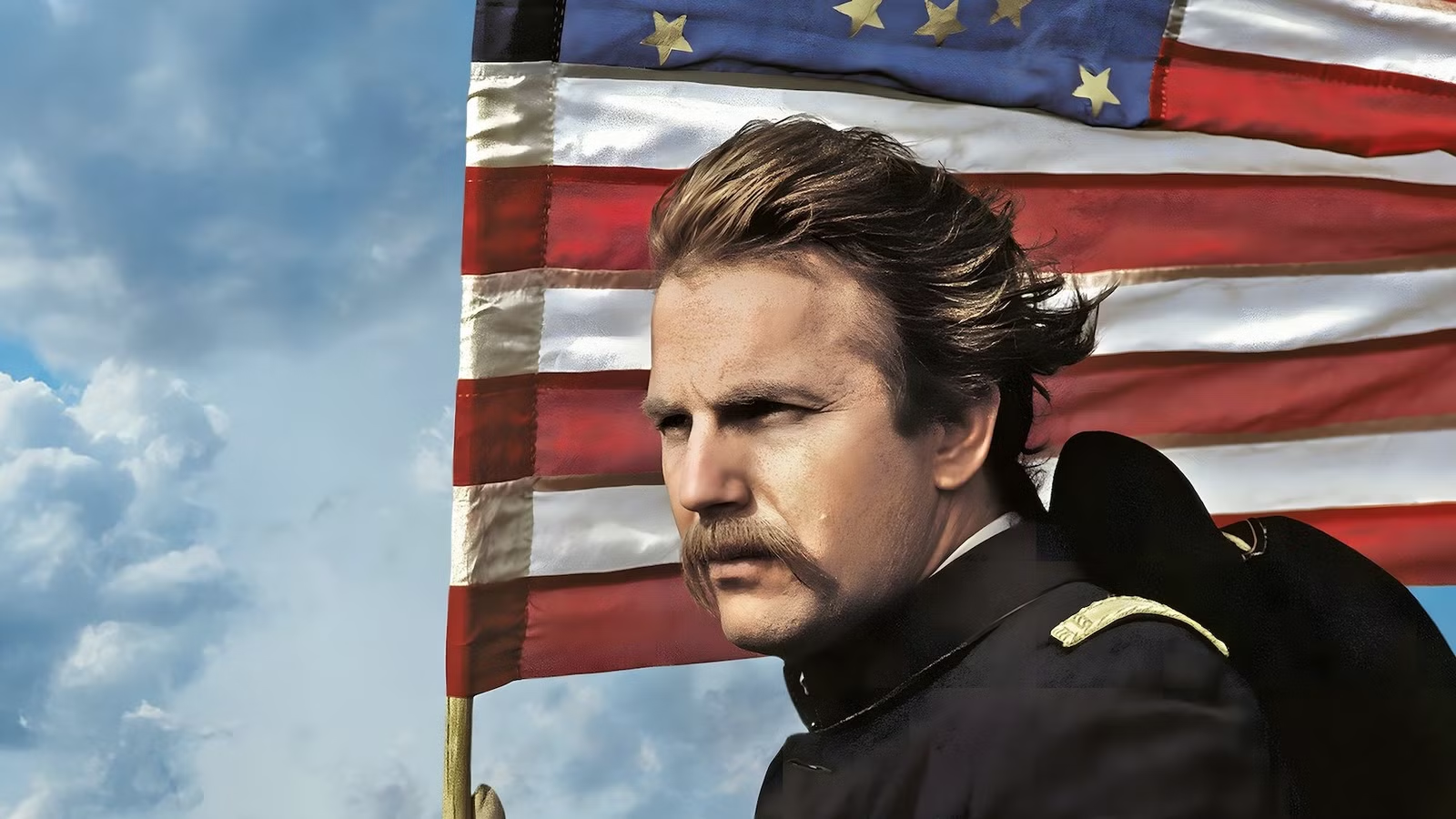
Kevin Costner‘s Dances with Wolves changed that perspective as the movie earned more than $400 million worldwide and won seven Academy Awards, including Best Picture. Rather than relying on familiar shootouts and clear-cut heroes, the film presented Native Americans with humanity and explored the American frontier through themes of identity and cultural understanding. Its enormous success is the reason we have Unforgiven and Tombstone. Recently, Costner himself had a hand in popularizing neo-Westerns on TV with Yellowstone, but his new theatrical effort Horizon: An American Saga stumbled, proving that the genre is still tricky to tread on.
‘Bonnie and Clyde’ (1967)

Despite their enduring popularity today, gangster movies had a long hiatus after its peak in the 1930s with movies like Little Caesar and the original Scarface. This is also somehow affected by the censorship at the time which forces movies to end with the criminals repenting or punished, creating little variation in the films. When Bonnie & Clyde was released, it was a phenomenon because it was based on real-life outlaws and pushed the story beyond traditional censorship limits.
Bonnie and Clyde was a sleeper hit when it was released, spending 22 weeks in the top 12 box office. It also received ten Oscar nominations and won two. Its style of filmmaking that blended French New Wave with shocking violence and rebellious tone captured the spirit of its time. Studios and filmmakers became convinced that it was time for the audiences to have more mature crime films. The movie directly paved the way for gangster masterpieces like The Godfather and Goodfellas, forever changing how Hollywood portrayed organized crime.
‘Pirates of the Caribbean: The Curse of the Black Pearl’ (2003)

Epic swashbuckling adventures that flourished during the Golden Age had steadily disappeared as costs were rising and audiences lost interest. For pirate movies especially, huge failures like Cutthroat Island buried the subgenre because the gamble was just not worth the risk. Pirates of the Caribbean: The Curse of the Black Pearl defied expectations when it was released. The concept of adapting a theme park ride was laughable and the large-scale production meant it had to gross hundreds of millions of dollars to break even.
Powered by Gore Verbinski‘s energetic direction and Johnny Depp‘s unforgettable performance as Captain Jack Sparrow, the film became one of the biggest blockbusters of 2003, launched a multi-billion-dollar franchise, and became a modern classic. More importantly, it demonstrated that swashbuckling adventures could still succeed when blended with modern blockbuster filmmaking. The film spawned four sequels, renewed interest in the genre. Its success not only broke the pirate movie curse but also the broader adventure genre that had struggled to find its footing after the heyday of Indiana Jones. It is yet to be seen whether the long-rumored Pirates of the Caribbean sequel/reboot will enjoy the same achievement.
‘The Lord of the Rings: The Fellowship of the Ring’ (2001)

Fantasy films had long been viewed as one of Hollywood’s riskiest genres. Although there were beloved classics like The Wizard of Oz and The Neverending Story, ambitious fantasy adaptations only drew a segmented audience yet they cost millions to produce. Throughout the 1980s and 1990s, fantasy films were often relegated to cult status, while several high-profile disappointments reinforced the belief that audiences simply weren’t interested in sprawling worlds filled with magic and mythical creatures.
Shooting three films back-to-back with relatively unknown cast and director, The Lord of the Rings trilogy was a huge gamble. When Fellowship of the Ring was released, it completely transformed Hollywood’s perception of fantasy. Peter Jackson’s faithful adaptation of J.R.R. Tolkien’s novel became a worldwide phenomenon, with the trilogy eventually earning nearly $3 billion at the global box office and collecting 17 Academy Awards. Together with the first Harry Potter that was released in the same year, the movie was responsible for the 2000s fantasy boom. In its wake, more fantasy films like The Chronicles of Narnia and The Golden Compass were released. Its influence is everlasting, because without it there probably would not be Game of Thrones also.
‘Moulin Rouge!’ (2001)
.jpg?q=49&fit=crop&w=500&dpr=2)
Movie musicals were once the bread and butter of Hollywood. But the lavish productions that once defined the studio system had largely disappeared after a string of expensive disappointments throughout the 1970s and 1980s. By the 1990s, the only musicals that were released were basically Disney animated movies like The Lion King. However, Baz Luhrmann‘s Moulin Rouge! brought new life to the dying genre.
Luhrmann smartly did not try to imitate classic Hollywood musicals. He eased audiences back into the genre by incorporating recognizable contemporary pop songs and then employed his maximalist kinetic style that heightened the visuals and the emotional narrative. The film connected with audiences and critics, and was nominated for eight Oscars and won two. Its success was rapidly followed by other studios that produced Chicago and The Phantom of the Opera. While the genre has not returned to its peak like in the Hollywood Golden Age, musical movies have been more accepted and enjoyed by more audiences, as evidenced by La La Land and Wicked.


