
At Cannes, the Specter of Hollywood Always Looms Large (Even in Its Absence)
The ghosts of Hollywood haunt the Cannes Film Festival, which kicked off Tuesday under a moody sky. That evening, when attendees streamed onto the world’s most famous red carpet for the opening ceremony, they did so under a looming billboard of the festival’s official poster. Every year, this star-struck event selects one or more cinematic icons to represent it, and for 2026 it chose Geena Davis and Susan Sarandon striking a pose in Ridley Scott’s 1991 feminist western, “Thelma & Louise.” The women look tough, resolute, sexy. They are also about to drive off a cliff.
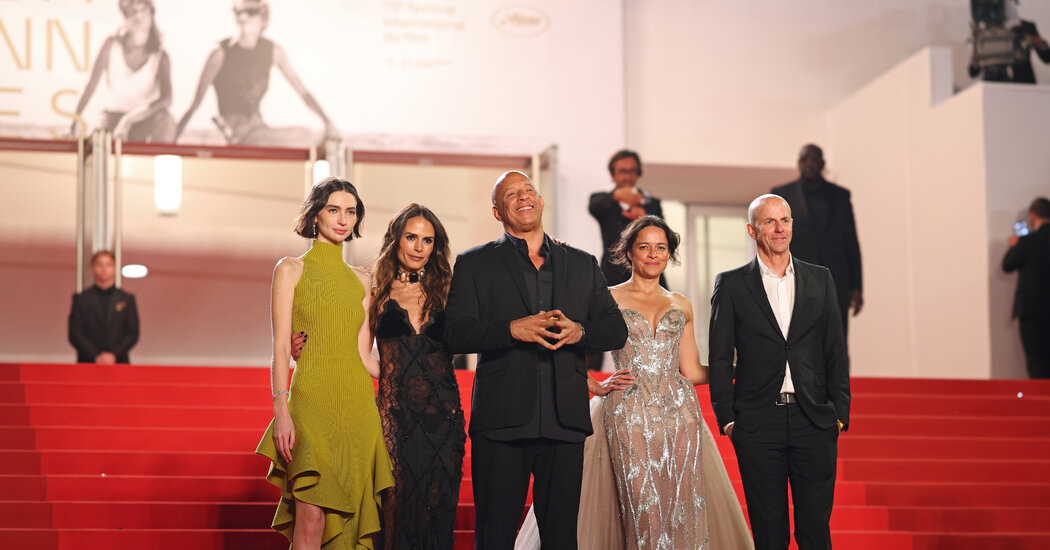
As an emblem of the glory of cinema and Cannes itself, “Thelma & Louise” is certainly a doozy; it’s also a reminder of how inextricably connected to Hollywood the festival remains. That’s been true throughout the event’s history, no matter how many actual American movies of any kind are in the official selection. This year there are relatively few, which means that there aren’t many globally recognized stars to feed the needs of the ravenous media here. One splashy exception: At midnight on Wednesday, the festival held a 25th anniversary screening of “The Fast and the Furious,” the 2001 street-racing fantasia from Universal Pictures that revved up the franchise. Les stars came out that night or at least Vin Diesel did.
Despite the vroom-vroom of fast, furious engines, the festival has gotten off to a quiet start. Each year, it strategically spreads its offerings across 12 jammed days, often waiting a tick before unveiling the most hotly anticipated titles. That said, even when the movies don’t blow the roof off, their quality remains consistently above average. The low-key drama “Nagi Notes,” from the Japanese director Koji Fukada, centers on the emotionally complicated reunion of former sisters-in-law and is anchored its appealing leads: Shizuka Ishibashi as an architect, Takako Matsu as a sculptor. The French drama “A Woman’s Life” is similarly low-key if less formally ambitious. Directed by Charline Bourgeois-Tacquet, it focuses on a middle-age surgeon who’s carved out a successful life that hasn’t been defined by children or romantic partners. It’s a perfectly pleasant movie — its star, Léa Drucker, is always worth watching — though it’s hard to believe that it would be in the main competition if it wasn’t French. Cannes is the most prestigious event of its kind, but it’s also an important showcase for French cinema and, as crucially, as a bulwark against Hollywood’s global domination.
There’s little quiet to be found in Jane Schoenbrun’s “Teenage Sex and Death at Camp Miasma,” a boisterous American comedy about sex and death, yes, as well as identity, bodies, flesh, fluid and the liberating ecstasies of cinema. Kris (a winning Hannah Einbinder, from the TV series “Hacks”) is a young filmmaker hired to revive a defunct slasher franchise. Hoping to crack the remake code, she seeks out one of original film’s stars, Billy (a vamping Gillian Anderson), a turban-wearing recluse who’s embalmed herself in her past like a Z-movie Norma Desmond. Stuffed with cinematic allusions and severed body parts, the movie is sweet, sincere and fitfully, goofily amusing.
The festival already has one incontestable competition standout in “Fatherland,” the latest from the Polish filmmaker Pawel Pawlikowski. Set in Germany shortly after the end of World War II, this perfectly cut jewel of a movie revisits an unexpectedly fraught trip that the writer Thomas Mann (Hanns Zischler) made to his ruined homeland in 1949. Pawlikowski has taken some fictional liberties; Mann made the journey with his wife, Katia, but here is accompanied by his attentive daughter Erika (the great Sandra Hüller). The power of the movie creeps up on you with its emotional restraint, the beauty of its black-and-white images and the delicacy with which Pawlikowski explores the devastations trembling under the faces of both father and daughter. You’ll be hearing a great deal more about “Fatherland” when it opens.
That there are no big studio movies in the main competition — the high-profile section in which titles vie for the Palme d’Or — has received much attention from the American trades, never mind that, like the Oscars, Cannes invariably mirrors the larger forces shaping the industry. In April, after the festival announced its lineup, The Hollywood Reporter asked if the absence of the big studios meant that they had a “growing fear” of festivals. Thierry Frémaux, the Cannes artistic director, tartly responded by suggesting the lack of studio movies was a loss for Hollywood: “When the studios are less present in Cannes, they are less present full stop.” In truth, the big American studios have long been leery of this event. “Cannes is the kiss of death,” a Paramount executive said in 1980. “It means that a film is artistic.”
There are sensible reasons that some companies skip Cannes, and avoiding potentially damaging negative notices is a significant one. I’m not the only critic who remembers the boos that hit Richard Kelly’s “Southland Tales” like a tidal wave when it showed here in 2006. At the same time, you can’t program something that doesn’t exist, and if there aren’t a lot of studio movies here, it’s partly because there aren’t all that many studio movies period. Last year’s release of “Sinners” and “One Battle After Another,” both critical and commercial hits from Warners, was a near-anomalous event in a mainstream sector now largely dedicated to recycling canned goods.
Among the American directors in attendance this year are Ira Sachs, an independent filmmaker whose “The Man I Love” stars Rami Malek as a gay performance artist in the New York of the late 1980s. It’s in the main competition as is “Paper Tiger,” another New York drama set in the 1980s, this one from the writer-director James Gray and starring Adam Driver, Scarlett Johansson and Miles Teller. Gray is a festival favorite — “Paper Tiger” is his sixth movie in the main competition — and tends to connect more with critics than with the public. He’s left an imprint on other filmmakers to judge from “Butterfly Jam,” a messy Gray-esque crime saga set in New Jersey from the Russian filmmaker Kantemir Balagov; it’s in Directors’ Fortnight, one of several separate programs that run during Cannes.
“Paper Tiger” will be released in the United States by Neon, an American movie company that has grown exponentially in size and international muscle in recent years. It released both “Anora” and “Parasite,” each of which won the Palme before going on to win the Oscar for best picture. Neon has nine movies at Cannes this year, including “All of a Sudden,” from the Japanese writer-director Ryusuke Hamaguchi, best known for “Drive My Car.” His new movie largely takes place in France, and while it hasn’t yet screened, word on it is already very strong. It will be up to the main jury — led this year by the South Korean filmmaker Park Chan-wook — to decide just how strong.
The ascension of Neon is another index of how the American movie industry — and that amorphous entity that we insist on calling Hollywood — has changed. The old studio model was committed to a profitable and popular diversity of entertainments (westerns, romances, comedies, war movies), some from directors who were deified as auteurs by French film critics. Today, by contrast, the American movie landscape can be roughly divided into two separate and unequal segments. On one side of the divide are the blockbusters that dominate the box office; on the other is everything else, from the negligible to the essential, from the trashiest genre flicks to the most ecstatically received art films.
Cannes has more or less adapted to these changes, but the rise of the Hollywood blockbuster means that the festival has needed to look beyond the major studios for new American auteurs. That it has continued to do so by showcasing filmmakers like Sean Baker, the writer-director of “Anora,” is a testament to the festival’s savvy as well as to the medium’s vitality and power of regeneration.
The emphasis at Cannes on old American movies can sometimes seem like dusty nostalgia, but it’s both commercially shrewd and fundamentally idealistic. The major studios aren’t what they once were, but — as the continuing commercial exploitation of dead stars like Marilyn Monroe prove — Hollywood and its ghosts continue to enthrall the world. If nothing else, Cannes knows that holding onto the past is one way to keep faith in the future.


