
6 Praiseworthy Adventure Movies That No One Remembers
If you’ve spent any time on this site or any site like it, you’ve likely come across an article or two listing out some of the most forgotten, underrated, or otherwise overlooked adventure films. Despite the ubiquity and popularity of the genre, which has informed and become an integral part of the blockbuster formula, there are a great many films within it that somehow fail to register in our collective pop culture consciousness. Many of them are good, some are great, some have aged like fine wine, and some are near-perfect, but they’ve all been lost somewhere in the sands of time.
While essential adventure movies like Raiders of the Lost Ark or The Princess Bride dominate the conversation and get all the fortune and glory, it comes at the expense of many other films that are deserving of praise. They may or may not be perfect, but they all have something to offer the genre, from rip-roaring, high-stakes to crowd-pleasing adventures that can be enjoyed from the comfort of your couch. If you’ve got a Saturday night to spare and are in the mood for some thrills, these six praiseworthy adventure movies that no one remembers have got you covered.
‘Without a Clue’ (1988)

Sherlock Holmes has been adapted to film more times than almost any other fictional character, save for Count Dracula. From the classic days of Basil Rathbone to the action-packed ones featuring Robert Downey Jr., the character has been interpreted and reinterpreted for every generation of audiences. In the ’80s, there were two unique takes on the character. The first was Young Sherlock Holmes, which depicted the school days of Arthur Conan Doyle‘s detective and which has become a minor cult classic, best known for featuring the first fully CGI character on screen. The second was the criminally forgotten Without a Clue, a comedic adventure starring Michael Caine and Ben Kingsley that flips the script on Holmes and his faithful companion Dr. Watson.
In this rendition, Dr. Watson (Kingsley) is the genius detective, and Holmes (Caine) is a washed-up actor hired by him to play a fictional role created as a means to avoid unwanted attention. Watson soon tires of the character and the theatrics of the actor playing him, and fires him in an attempt to step into the limelight himself, but finds that Scotland Yard and the public only trust in the man in the deerstalker cap. The film offers a fun twist on the characters, and Caine and Kingsley are delightful together, fully engaging in their characters’ buffoonery and exasperation, respectively. Without a Clue is enjoyable on an elementary level, and the only mystery surrounding it is why it’s been so undeservedly forgotten.
‘The Rescuers Down Under’ (1990)
There are more than a few animated adventure movies that were done a disservice upon their original release and left in the dust by audiences. The 2000s, in particular, were an era where many animation studios were attempting old-fashioned adventures. Movies like The Road to El Dorado bombed at the box office but were given reappraisal and recognition later on, while Disney tried twice to enthrall audiences with the vastly underrated Atlantis: The Lost Empire and Treasure Planet. Both those movies from the House of Mouse have accumulated cult followings, but go back just a decade, and you’ll find a forgotten Disney adventure sequel that’s the best of them all. The Rescuers Down Under was a belated follow-up to the original 1977 film, which was loosely based on a series of books by Margery Sharp and featured two mice who work for the Rescue Aid Society to save children in peril.
The original was a success and got decent reviews, but the superior sequel failed at the box office, becoming the one black spot during the Disney Renaissance era. That dubious status is wholly unearned, as the film is a gorgeously animated adventure with loads of laughs. It features the return of rescue mice Bernard (Bob Newhart) and Bianca (Eva Gabor) as they set off for the land down under to save a boy abducted in the outback by the menacing poacher McLeach (George C. Scott). The voice cast is perfect, including incredible comedic support by John Candy, taking over for Jim Jordan, as the mice’s preferred method of albatross transportation. The use of emerging digital technology also makes it stand out visually and gives the action a more visceral quality than any prior Disney adventure. The Rescuers Down Under is a classic in every way except by reputation.
‘The Three Musketeers’ (1993)

The Three Musketeers are woven into the very fabric of adventure storytelling, with the original swashbuckling novel by Alexandre Dumas a seminal work of the genre that has been brought to life on film a number of times, most notably in a two-part adaptation starring Oliver Reed and Michael York. That two-part approach was taken again in the most recent French adaptation featuring Vincent Cassel and Eva Green. Between those two critically acclaimed diptychs, Disney tried their hand at the material with a hot young cast that was cut up by critics in 1993. The film was derisively compared to the popular Young Guns films due to both featuring stars Keifer Sutherland and Charlie Sheen, and while it doesn’t compare to the best adaptations of Dumas, it’s a breezy adventure that offers undemanding thrills and has a killer supporting cast.
The film recounts the basic tenets of the classic plot, following young D’Artagnan (Chris O’Donnell) as he joins with the musketeers in their battle against the corrupt Cardinal Richelieu (Tim Curry). As directed by Stephen Herek, the film features plenty of sword and wordplay, all of it very competently executed and which looks far better in retrospect, given that it’s devoid of any unnecessary digital effects and relies on real stuntwork. The lead character may be a bit bland, but the rest of the musketeers are having fun, especially Oliver Platt as the boisterous Porthos, and Curry absolutely devours the scenery as the villain. Add in Michael Wincott as a gravel-voice secondary antagonist, and there’s too much fun to be had in this incarnation of the classic story to dismiss it.
‘The Count of Monte Cristo’ (2002)

Perhaps second only to his tale of the musketeers, Dumas’ best-known work is the classic revenge story of The Count of Monte Cristo, which has similarly been adapted multiple times on film to varying degrees of success. The most forgotten of those adaptations is the solid 2002 effort directed by Kevin Reynolds and starring Jim Caviezel and Guy Pearce. It isn’t the most faithful of adaptations, but it still delivers the adventure goods with plenty of romance, sword fights, and vengeance. Pearce and Caviezel are also dynamic in the lead roles, giving the film more excitement than some lesser adaptations of Dumas, such as the maligned The Man in the Iron Mask.
The basics of the plot remain intact as Edmond Dantes (Caviezel) is betrayed by his friend Fernand Mondego (Pearce) and imprisoned for years until later escaping and plotting his revenge. Reynolds knows how to stage action, having previously helmed the Kevin Costner vehicle Robin Hood: Prince of Thieves, and the streamlined plot focuses the film on the most rousing elements of the novel. The extended cast is also equally effective, with solid support from Richard Harris, Michael Wincott (again), and Henry Cavill in an early role. Swashbucklers have never reclaimed the former glory they once held in Hollywood, so any earnest attempt at one should always be appreciated, and The Count of Monte Cristo is one of the better efforts of the 21st century.
‘Sky Captain and the World of Tomorrow’ (2004)

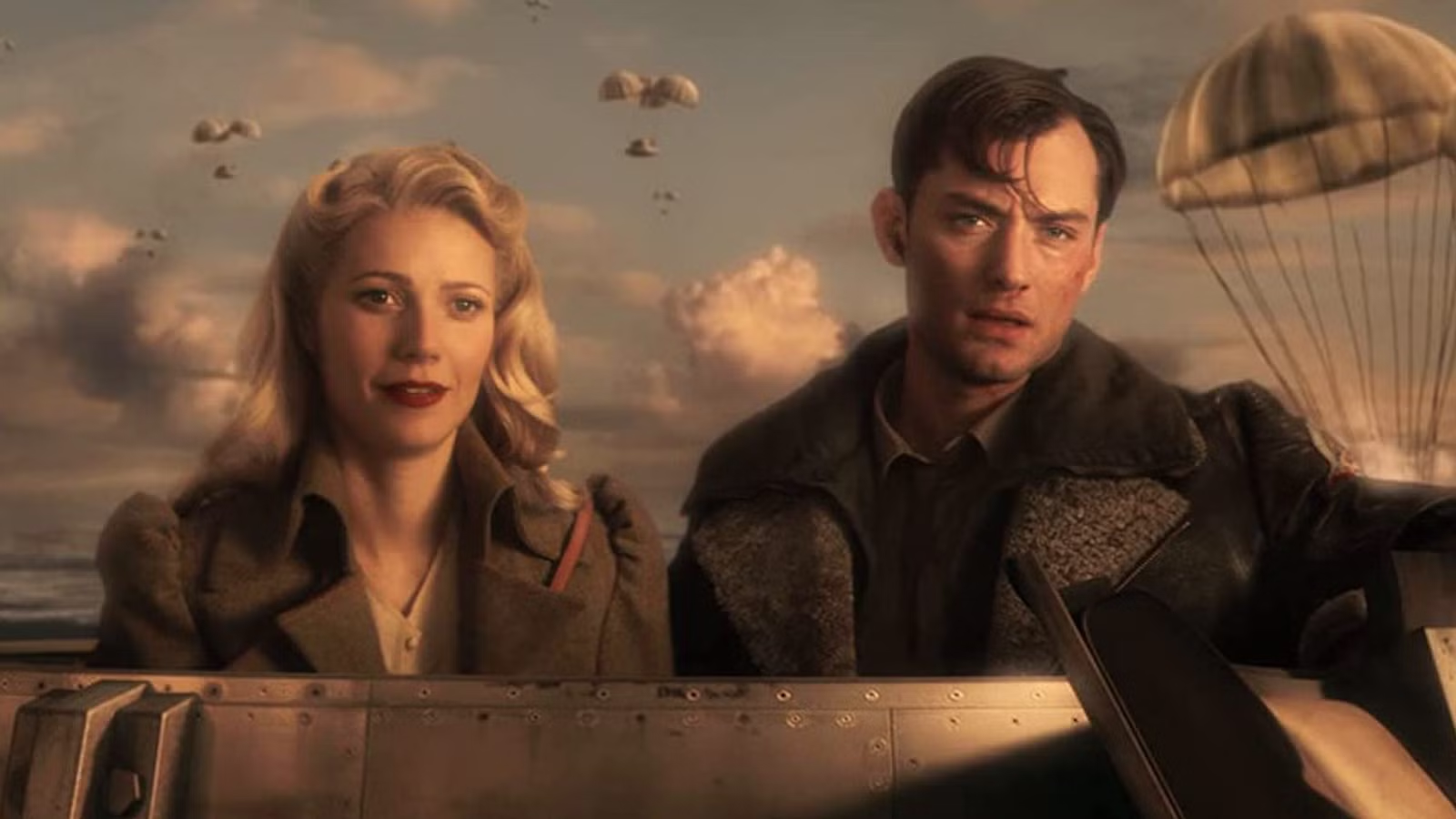
As both a throwback to pulp adventures and a precursor to Hollywood’s digitally-reliant productions, Sky Captain and the World of Tomorrow occupies a strange space in adventure film history. While Raiders of the Lost Ark set a standard for modern adventure movies that has proven impossible to clear, some efforts manage to recapture a little of that film’s magic. The Rocketeer has previously been mentioned in this capacity, and The Rundown is a fun 2000s version that also borrows from Midnight Run, but Sky Captain stands out for its unique visuals and considerable lack of cultural footprint. The film was shot entirely on bluescreens, with the environments completely digitally, a common practice on many films now but an unusual technique in 2004. The style may have been what kept some audiences away from the film, which crashed and burned at the box office but should be appreciated for its visuals alone.
Set in an alternate history dieselpunk version of the 1930s, the film follows the titular Sky Captain (Jude Law), a high-flying mercenary, as he investigates the disappearances of several scientists alongside his former paramour, reporter Polly Perkins (Gwyneth Paltrow). The film’s visuals pull directly from Golden Age Comic Books and pulp magazines, and it’s possibly the most perfect representation of their distinctive style on film. Director Kerry Conran, whose career never took off, spent years developing Sky Captain and created a short film as proof of concept. His passion for the material is evident in every frame, and while these kinds of old-fashioned adventure movies generally only appeal to a niche fandom, they shouldn’t become lost treasures.
‘Togo’ (2019)

Based on the true story of the 1925 dogsled serum run, Togo seeks to right the wrongs of the past by properly attributing credit to the titular heroic dog that led the longest and most treacherous parts of the run. Unfortunately, Togo was unceremoniously dropped on Disney+ in late 2019 and was just as quietly removed from the streaming service in 2024. It is not currently streaming anywhere. It’s a forgotten movie about a forgotten dog and a story that deserves a much larger audience, a solidly made adventure that, in any other decade, would have had a long life as a beloved rental.
When a diphtheria outbreak occurs in the remote Alaskan town of Nome, severe weather prevents the air delivery of the necessary antitoxin, leaving dogsleds as the only option. A relay effort between dog sled teams is coordinated, with the majority of the runtime devoted to musher Leonhard Seppala (Willem Dafoe) and his lead dog Togo. If the story sounds familiar, it’s the same one that was told in the ’90s animated movie Balto, which took obvious major liberties and continued the misattribution of Togo’s efforts to the dog Balto, who only led the last leg of the journey. Togo is a far more faithful effort that’s worthy of as much praise as the good boy it’s named after.


