
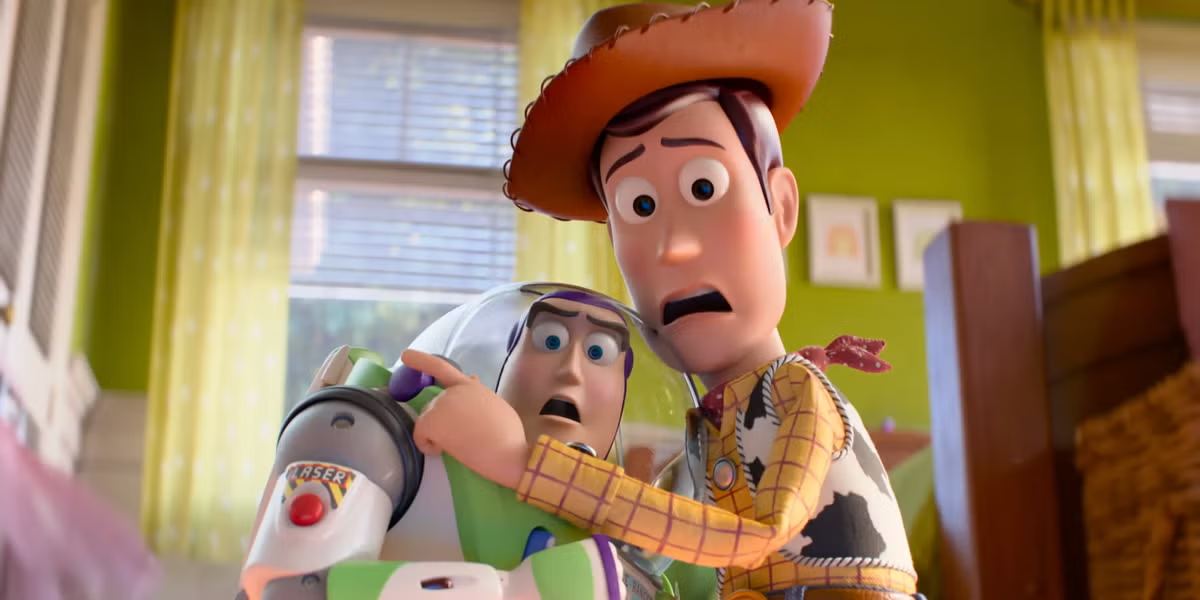
Every Pixar Movie, Ranked from Worst to Best

Spun from the legendary Lucasfilm in 1986, Pixar was, and remains, a powerhouse in cinematic animation. With more than 30 full-length feature films and countless shorts and specials, Pixar has entrenched itself in the hearts and memories of generations everywhere. We all have our favorites, but which movies from Pixar are truly the best of all time?
In 1979, just two years after Star Wars blew up the box office, George Lucas hired computer scientist Ed Catmull to lead a graphics division at Lucasfilm. Catmull harbored dreams of producing the first computer-animated movie, and so Pixar worked toward that goal by spending the 1980s homing in on the burgeoning visual-effects industry and creating techniques from motion blur to digital compositing. Some of the earliest feature-film work credited to Pixar includes effects on the seminal sci-fi blockbuster Star Trek II: The Wrath of Khan. (An all-time great movie, if you’ve never seen it.)
In 1986, Steve Jobs—yes, that Steve Jobs—bought the division and turned it into Pixar. It was basically a computer-hardware company that sold (poorly, at that) to government and medical clients; Pixar made animated short films to advertise itself. In 1988, the Pixar short Tin Toy won the Academy Award for Best Animated Short Film, which gave the studio credibility and proved that computer-made movies were no flash-in-the-pan trend. In 1991, the struggling Pixar struck a deal with Disney to produce a fully CG movie. You can guess where the story goes from there.
Today, Pixar is known for its heartfelt features that appeal to all ages. It’s created iconic characters from toys, monsters, robots, and superheroes. Though some may argue its quality has faltered over time, it remains an indelible part of multiple generations’ childhoods—and, let’s face it, adulthoods too.
From the messes to the masterpieces, Esquire ranks all 31 theatrical feature films by Pixar from worst to best. See where your favorites landed, and feel free to yell at us for getting it wrong. Just remember: You’ve got a friend in us.
31. Monsters University (2013)
More than a decade after Monsters Inc. imagined a world of scary monsters as a workplace comedy, Monsters University functioned as a prequel in the vein of a G-rated Animal House. But while the college antics of blob monsters and fuzzy creatures in the throes of young adulthood are cute, Monsters University simply never answers the most important question posed in all sequels and prequels: Why did we need this?
30. The Good Dinosaur (2015)
The Good Dinosaur was the first time that Pixar, a once invincible studio, ever took a beating at the box office. Even a decade later, time hasn’t softened us to this nonstarter of an adventure flick. Set in an alternate Earth on which the dinosaurs never went extinct, The Good Dinosaur sees the unlikely friendship between an apatosaurus and a feral human cave boy. Critics were lukewarm on The Good Dinosaur, and audiences largely avoided the movie when it opened in November 2015—which, for a studio that also released classics like Toy Story, Wall-E, and Up, marked the first time Pixar ever flirted with extinction.
29. Cars 2 (2011)
The success of Cars and its endless merchandising potential meant a sequel was a no-brainer. But that didn’t give Pixar license to be so absent-minded at the wheel. Cars 2, released in 2011, sees the return of Lightning McQueen as he competes in the World Grand Prix only for his pal Mater to get mixed up in some nonsensical spy-movie espionage. When the first Cars came around, it was seen as Pixar’s most cynical, cash-grabbing franchise; Cars 2 did nothing to prove otherwise.
28. Elemental (2023)
The meme that Pixar movies are nothing but “What if [insert noun here] had feelings?” is so played out. But inaccurate? Not with movies like Elemental. This late-era Pixar release is part modern fantasy, part star-crossed romantic comedy in which the hot-tempered Ember, a living fire element, meets the emotional Wade, a water element. Together, they team up to save Ember’s father’s convenience store. Though its allegories of the immigrant experience are profound, that doesn’t make Elemental memorable or even fun. And with vibrant, culturally specific movies like Coco in the Pixar library, it begs the question why Elemental aimed to be so abstract.
27. Finding Dory (2016)
Critics and audiences loved Finding Dory, but 2016 was a very long time ago. In the decade since, Finding Dory has struggled to keep afloat in either the Pixar or Disney library, and for all its individual merit, it just can’t outswim its predecessor. In Finding Dory, the forgetful blue Dory (voiced by, well, Ellen DeGeneres) follows traces of her faint memory of her parents to the California coast. This sequel to Finding Nemo intentionally echoes the original in terms of its plot and themes; while there are worse movies a sequel could imitate, you could always just watch Finding Nemo again.
26. Cars 3 (2017)
The unsuspectingly gritty teaser trailer for Cars 3 suggested the third installment in the series would take a sharp left turn into more serious, maybe even realistic territory. It didn’t. But Cars 3 still flirts with existential dilemmas enough to suggest there’s maybe more going on under the hood than its wax-polish looks imply. In Cars 3, the veteran McQueen is confronted with his sagging horsepower amid a rivalry with a new upstart in the Piston Cup: Jackson Storm (voiced by, uh, Armie Hammer). Cars 3 doesn’t live up to the potential it once promised, but its story about aging and relevance is deep for a movie ready-made to sell more toys.
25. Elio (2025)
In early 2026, Elio wound up the center of a cultural shitstorm when Pixar’s Peter Docter told The Wall Street Journal that he removed an LGBTQ storyline from the movie because “we’re making a movie, not hundreds of millions of dollars of therapy.” It’s a harsh sentiment that’s also not entirely wrong. Pixar’s post-2020 features are heavily rooted in the deeply personal experiences of its filmmakers, and they’ve struggled to sell tickets in the way the studio’s early hits did. But when you learn that Elio’s potential was hampered in production for the sake of making it more mainstream, you can’t help but wonder if the safer bet was the riskier movie. In the end, what we’re left with in Elio is a safe, inoffensive movie about a boy and an alien invasion that many other movies, even ones from Disney, have already done better.
24. Soul (2020)
Christmas 2020: It was hard to be jolly after a difficult and traumatic year. Pixar saw fit to spread the gift of cheer by releasing what was its latest movie at the time, Soul, onto Disney+ for “free” (if you already had a paid subscription—there was that whole “Premier Access” thing, if you recall). Soul was the right movie for that moment in time—but maybe not so long afterward. In this existential comedy fantasy, an unhappy music teacher named Joe (Jamie Foxx) dies in a freak accident, only for his soul to comically inhabit a cat’s body. The whole movie is about living the one life you have to the fullest, which was an especially powerful message during a deadly pandemic. But Soul feels like several different movies at once, and like a lot of things from Covid-19, we’d rather not revisit this one so often.
23. Lightyear (2022)
Chris Evans’s infamous tweet trying to clarify the premise of Lightyear is still hilarious, but Disney’s exploration of Buzz Lightyear’s in-universe canon isn’t new. (Real quick: Google Buzz Lightyear of Star Command.) By 2022, Pixar was all too eager to retread old territory, so it delivered the first theatrical spin-off of the famed Toy Story series. Lightyear imagines itself as the movie Andy saw that led him to getting his favorite Buzz Lightyear toy. And what Andy saw was a rousing space adventure that feels part Interstellar and part Gravity, if both were made for children. (It also does not resemble a film from 1995 in the slightest, but whatever.) Better than it sounds but still short of proper brilliance, Lightyear is a novelty experience whose stakes are cut off at the knees by what the film says about itself from the jump: It’s a movie about a toy.
22. Inside Out 2 (2024)
Where 2015’s Inside Out is about a child understanding her feelings, its 2024 sequel is about how she starts over once she hits puberty. Riley Andersen, now 13 years old, navigates strange new emotions like envy, ennui, and anxiety, which throw her emotional chemistry off-balance. Inside Out 2 is cute and smart, but as its very title implies, it’s just more of the same.
21. Hoppers (2026)
Following a down period in the 2020s when most Pixar movies were interchangeable duds, Hoppers came along and brought back some of the ol’ razzle-dazzle. In Hoppers, brilliant college student Mabel becomes part of an experiment in which her consciousness is placed into a robotic beaver to establish verbal communication with the animal kingdom. After some time and hilarious mishaps, Mabel finds herself at the center of a four-legged revolution against humankind. Half Avatar and half Animal Farm, Hoppers is a surprisingly sharp laugh riot that may prove itself over time.
20. Incredibles 2 (2018)
In the years between The Incredibles in 2004 and its 2018 sequel, studios like Marvel and DC amassed inordinate power to make superheroes the biggest movie genre of the 21st century. (At least for a time.) It was amid this dominance that Pixar brought back its own fantastic family with Incredibles 2. Flipping the script of its predecessor, the sequel places Elastigirl front and center to explore womanhood in the modern workplace. Can a woman really have it all? Can a man’s place be the home? These aren’t questions you’d expect a Disney/Pixar cartoon to explore, but Incredibles 2 does so with gusto, even if the novelty of a superhero adventure from Disney feels impossibly quaint in the same year Avengers: Infinity War hit theaters.
19. Turning Red (2022)
One of the more “realistic” movies in the Pixar library, 2022’s Turning Red dared to probe girlhood on a biological level while presenting itself as a metaphysical modern fantasy. Set in the early 2000s, Toronto tween Mei Lee splits time between obsessing over boy bands with her best friends and dealing with her deeply traditional Chinese immigrant family. An old family curse begins turning Mei into a giant red panda whenever her emotions overflow. The pandemic-era box office meant many audiences didn’t turn up for Turning Red, but the movie has become one of Pixar’s most underrated gems in its modern run.
18. Brave (2012)
Katniss Everdeen wasn’t the only skilled cinematic archer of 2012. That year, Pixar released Brave, a rousing fantasy set in medieval Scotland. Shortly after the rebellious princess Merida refuses to marry, her family suffers a curse that forces Merida to save her kingdom. Once upon a time, Brave’s defiance of Disney’s entrenched gender-oriented story tropes felt bold. These days, Brave is simply a very good (and often visually stunning) storybook-style adventure with an unforgettable lead heroine.
17. Onward (2020)
When Onward hit theaters, Pixar rolled a natural 20 on its story—and an unlucky natural 1 on timing. Set in a world where magic yielded to modern conveniences (like electricity), two elf brothers embark on a not-so-epic quest to find an artifact that could bring back their deceased father for a short time. Heavily inspired by tabletop RPGs and Dungeons & Dragons—to the point that publisher Wizards of the Coast is given thanks in the end credits—Onward surpasses expectations to be a heartfelt tale about brotherhood and finding magic in the mundanity of life. You might have missed out on Onward for an understandable reason, however: It opened in theaters on March 6, 2020, mere weeks before widespread pandemic quarantine.
16. Luca (2021)
Call Me By Your Name? Not quite, but Luca is another sun-drenched summer dalliance through Italy from the perspective of impressionable boys. In Luca, two transforming sea monsters spend a life-changing summer exploring the human world. While director Enrico Casarosa insists he wasn’t influenced by Luca Guadagnino’s 2017 drama—Casarosa cites his own childhood growing up in Italy, as well as the works of Federico Fellini and Hayao Miyazaki—you simply can’t watch a movie about boyhood in the Italian summer and not feel like the movie is just one bite of a peach away from crossing that line.
15. Cars (2006)
When Cars raced into theaters in 2006, it quickly entered the bottom ranks of the Pixar canon. Looking back, perhaps we were unfairly harsh as a society. Inspired by director John Lasseter’s family road trip down Route 66, Cars imagines a world of sentient, anthropomorphic vehicles—with the hotshot Lightning McQueen as the number-one racer in the world. (Ka-chow!) When Lightning is stranded in rural Radiator Springs, the spoiled superstar learns what it means to be a proper winner. Cars still feels like a merchandise-driven movie for kids, but among falling standards of quality, Cars has tighter traction than we might have originally thought.
14. A Bug’s Life (1998)
After Pixar wowed the world with Toy Story, its follow-up again looked at the expansive worlds beneath our feet. A Bug’s Life follows the efforts of one tiny worker ant who, to make up for jeopardizing his colony with their grasshopper overlords, searches for brave heroes to help them fight back. What he finds instead are a troupe of literal clowns desperate for a payday (but they don’t need to tell him that). Though the movie didn’t reach the same lofty heights as Toy Story, A Bug’s Life was good enough to bolster Pixar’s reputation and allowed the studio to continue refining its groundbreaking animation techniques.
13. Toy Story 4 (2019)
The towering stature of Toy Story 3 meant that any continuation would face an uphill battle. In 2019, Toy Story 4 did the impossible to become a worthwhile epilogue to an undisputed masterpiece. In Toy Story 4, Woody confronts the reality that his time as a toy is at its end. Bonnie has more than enough toys in her closet, to say nothing of her own imagination. (See: “Forky.”) The first Trump administration was an appropriate time for Toy Story to introduce a character who wakes up screaming, but the real meat of Toy Story 4 is how it wisely explores existential concepts like relevancy and self-worth. Who knew that children could have a movie about retirement?
12. Toy Story 5 (2026)
Is Toy Story 5 actually better than Toy Story 4? Really, any Toy Story after the third one is just another victory lap. But Toy Story 5 finds more to say about the preciousness—and precariousness—of childhood as the toys meet a new enemy: technology. Taking the plague of “iPad babies” to task, the toys—this time led by Jessie—confront the bleak reality of kids everywhere ditching their plastic playthings in favor of digital stimulation. Because no one has the right answer to what playing “should” look like, Toy Story 5 proposes a middle ground where the only important thing is whatever fosters health and happiness.
11. Inside Out (2015)
Inside Out sounds like Pixar’s most complex film ever made—because it is. A film about feelings, the movie takes place “inside” the mind of young Riley Andersen, whose strong emotions are represented by avatars that operate in tandem to create the full human experience. Behind the scenes, Pixar consulted psychologists and neuroscientists to understand the unwieldy nature of human consciousness. The end result of all that work is Pixar’s most introspective movie that is, somehow, straightforward and easy enough for even children to understand.
10. Monsters, Inc. (2001)
Pixar’s reputation was solid after Toy Story 2, but after Monsters, Inc., it entered a whole ’nother league. Released in 2001, Monsters, Inc. imagined the scary monsters from under our beds as little more than office workers clocking in for another shift. When a human child infiltrates their forbidden world, two monsters work to keep her presence quiet—all while growing closer to her in the process. “What if monsters could be our protectors?” is a pitch that, in Pixar’s hands, doesn’t just work but also functions beautifully in a story about fear, bravery, and love.
9. Ratatouille (2007)
Ratatouille could have just delivered on its title’s pun for 90 minutes and called it a day, but this classic from 2007 wound up so much more flavorful than takeout. Set in modern France, a nervous but ambitious chef develops an unlikely partnership with a food-loving rat who firmly believes that quality is worth the effort. One of the movie’s more lasting themes is how our taste is defined by our personhood and that fine art rests simply in the eyes—or, rather, mouth—of the beholder.
8. Toy Story 2 (1999)
Putting aside the fact that Toy Story 2 was almost completely deleted during production (look it up; it’s a wild story), the sequel to the 1995 megahit proved that Pixar, and these characters, was no one-hit wonder. In this follow-up from 1999, Woody is “kidnapped” by a rabid collector who prepares to sell him to a toy museum in Japan. Along the way, Woody discovers his own forgotten “heritage” as the centerpiece to a massive western-themed kids’ franchise. (It’s an inverse to Buzz’s arc from the first movie, basically.) The movie would be solid on its own, but the midpoint sequence of Jessie’s origins—set to “When She Loved Me,” performed by master heartstring puller Sarah McLachlan—elevates the entire movie into something sublime. If you were around eight or nine years old when Toy Story 2 hit, you suddenly found yourself clutching your own toys a little closer than before.
7. The Incredibles (2004)
It took Marvel several reboots to figure out the Fantastic Four, but it took Pixar only one to get the formula down pat. In an era when superhero cinema still felt like fertile ground, Pixar put its stamp on the genre with the dazzling and propulsive classic The Incredibles. Set in a world where heroes have been forced into retirement and hiding from the public eye, the former Mr. Incredible resumes his old life in secret from his own family. Soon his superpowered family assembles as the one force to save the world from a new threat. Replete with golden-age aesthetics, The Incredibles is, to borrow a word from a certain comic-book literary mastermind, astonishing.
6. Finding Nemo (2003)
Just keep swimming, just keep swimming… Finding Nemo is a wondrous dive into the East Australian Current in this story about family, trust, and learning to let go without ever giving up. In Finding Nemo, an overprotective clown fish searches for his lost son in the vast ocean. Between its still-stunning animation, hilarious exploration of the ocean blue, and subtle touches of natural conservation, there’s a deeply emotional story about balancing responsible fatherhood with trusting that your children are resilient enough to handle themselves.
5. Up (2009)
The unbearably sad opening of Up is practically its own legend. But all of Up is a beautiful epic about old loves and new beginnings. In Up, an elderly and grumpy widower takes off to finally live out his late wife’s wildest dreams of relocating to exotic Paradise Falls in remote South America. But when he accidentally brings along an eager boy scout, he finds himself in an adventure much different from what he could have ever thought was coming. However sad Up will make you feel, it’ll also make you laugh and cheer in the ways only Pixar knows how.
4. Toy Story 3 (2010)
Even in 2010, movie sequels came with an expectation of diminishing returns. That is so not the case with Toy Story 3, which for a long time felt like an unquestionable final chapter in the saga. In the threequel, the beloved toys of the college-bound Andy wind up as donations to a nearby daycare. What seems like paradise turns out to be a prison, and the toys resolve to make it back to Andy before he’s gone forever. For a very specific cohort of millennials, we were Andy; released in June 2010, Toy Story 3 masterfully zeroed in on an audience heading to college themselves (and, broadly, all ’90s babies on the verge of adulthood). If Toy Story 2 had children holding their toys closer, Toy Story 3 allowed us to let go without forgetting the memories along the way.
3. Coco (2017)
Steeped in Mexican culture but universal in its themes about love, memory, and the afterlife, Coco is a lush musical fantasy set against the vivid tradition of Día de los Muertos. Set in Mexico, a young musician named Miguel is accidentally whisked away to the majestic Land of the Dead, where he hopes to reunite with a distant ancestor and restore a love for music in his bitter grandmother. With the showstopper “Remember Me” as a narrative and thematic linchpin, Coco dazzles with its abundance of heart and humor about the forces that connect us to our past. In the first year of the Trump administration, the movie’s allusions to immigration and passage between worlds were not lost on audiences.
2. Toy Story (1995)
The one that started it all. A groundbreaking feat of filmmaking and animation, the original Toy Story dared to go to infinity (and beyond) in its unusual depth with characters who feel deeply human despite their plasticity. In the first entry in the series, the status quo of a child’s bedroom toys is interrupted by the arrival of a fancy new toy: the red-hot and delusional Buzz Lightyear. No matter how much Pixar’s animation has evolved over 30 years, Toy Story remains the benchmark for Pixar and for animation studios everywhere.
1. WALL-E (2008)
Light on dialogue but heavy in its ambitions, WALL-E is an achievement of modern animation. Set in a distant future after humanity has long left Earth, the last robot tasked with cleaning up the ravaged planet makes a new friend in the cutting-edge EVE. As romance blooms between two bots, they journey into space to bring humanity back home. With wall-to-wall(-E) pro-environmental messaging and touches of condemnation of insatiable capitalist greed, WALL-E earns its place in the Criterion Collection and the top of this very list on the basis of its unbelievable sense of humanity.

