
Only 3 Movies Realistically Capture the Horrors of War
The war genre in movies is quite renowned. Since the dawn of the medium, the war genre has had a large presence in cinema, first influenced by World War I and then being directly impacted and outright reshaped by World War II. Subsequent conflicts like the Korean War, the Vietnam War, and the 21st-century wars in Afghanistan and Iraq have also been hugely important for cinema. At their core, and barring some jingoistic depictions that glorify the military, war movies are usually statements on the futility of armed conflict and the inherent destruction that it carries. Anti-war movies are their own subgenre, but overall, war cinema is all about why warfare ultimately only amounts to senseless destruction and the erosion of the soul.
It is commonly said that “war is hell,” and it’s true, but only a few movies have truly captured that sentiment on celluloid. Even the best war movies can often come short of depicting these large-scale conflicts in all their harrowing infamy, whether because they might be more concerned with another plot — perhaps a love story at the center or the impact of the experiences on a soldier’s psyche — or perhaps because their interest is to provide an entertaining story first and foremost. Indeed, only a precious few movies truly commit to portraying war as hell on Earth. They are logically not the easiest experiences, and all three movies on this list require varying degrees of psycholigical and emotional strength to endure. However, they remain among the most powerful statements cinema has ever made regarding the corrosive nature of war.
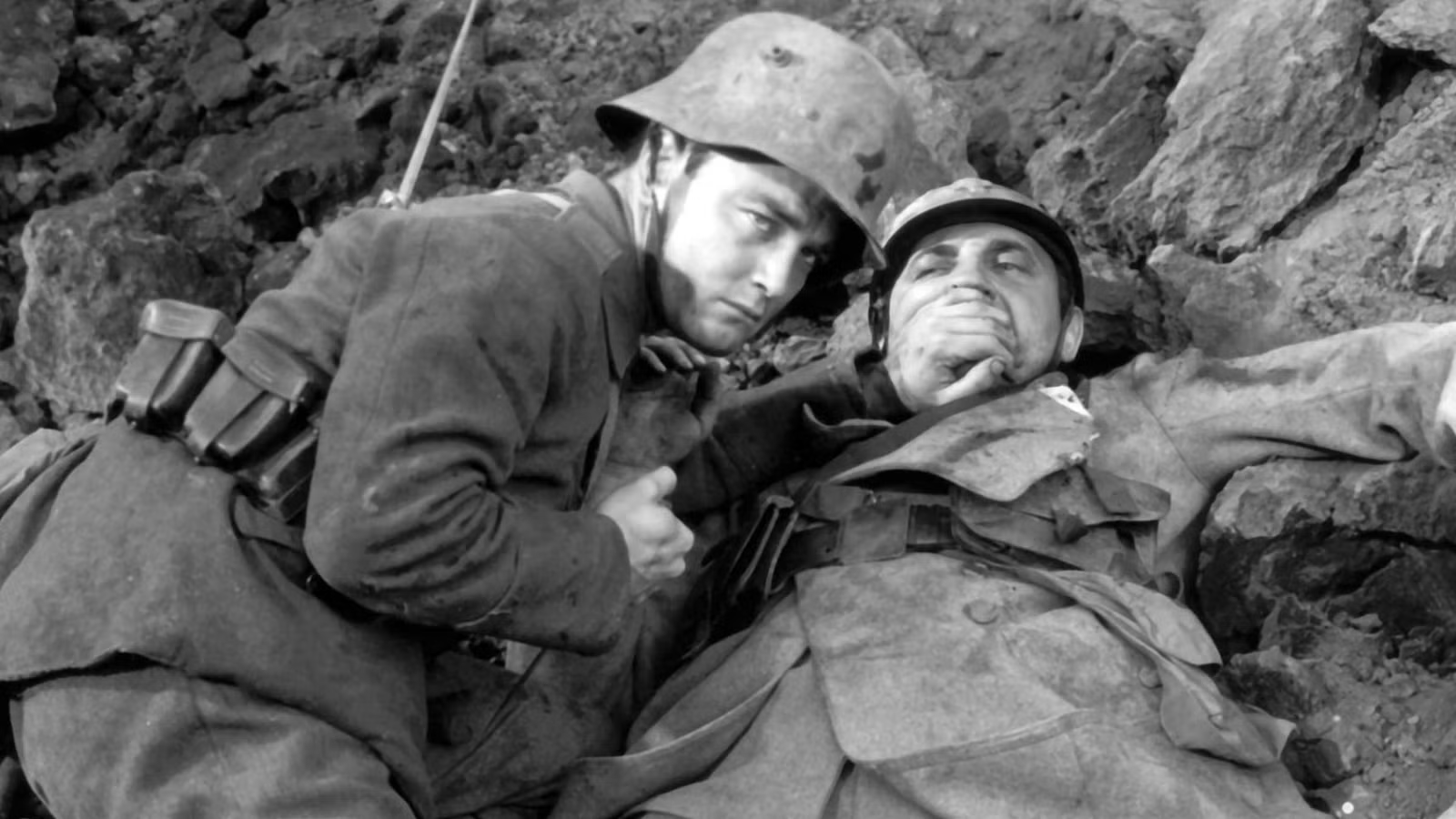
‘All Quiet on the Western Front’ (1930)

Based on possibly the most famous anti-war book ever written, Lewis Milestone‘s All Quiet on the Western Front is a gem of cinema that keeps getting better, more poignant, and more relevant with each passing year. The film adapts Erich Maria Remarque‘s magnum opus into a 152-minute tale of the fallacy of war and how young men fall into its trap. The plot centers on a group of German schoolboys who enlist at the beginning of World War I after falling for the propaganda spewed by their jingoistic teacher. However, they soon come to regret their actions, finding only despair, death, misery, and unimaginable pain in the trenches.
You know a movie is on the right side of history when Nazi Germany openly opposes it. All Quiet on the Western Front is a profoundly visceral experience, a tragedy of the trappings of war and the entire apparatus behind it, which convinces young men to sacrifice their lives for a cause they can’t quite understand. Like Remarque’s novel before it, Milestone’s movie humanizes these young soldiers, grounding their story in something painfully relatable before twisting it into something truly ugly and inescapable. At the center is Lew Ayres delivering an unflinching, unforgettable portrayal of a young man whose misplaced idealism leads him to a path of no return. All Quiet on the Western Front captures the breaking of the human spirit on the battlefield with such uncompromised commitment that it’s actually difficult to even finish it. The 2022 Netflix version is also a masterpiece, successfully updating a sadly timeless tale.
‘Come and See’ (1985)
Elem Klimov‘s Come and See is probably the best anti-war movie ever made. The 1985 Soviet movie stars an unforgettable Aleksei Kravchenko, in his acting debut, no less, as Flyora, a young Belarusian boy who joins a partisan unit during the Nazi occupation of Bielorussia during World War II. Through Flyora’s POV, we witness the atrocities committed during the conflict, particularly the grueling torture inflicted upon the civilian populace. Klimov uses a combination of agonizing hyper-realism with a borderline surreal approach to give the film an even more haunting and profoundly eerie quality.
Come and See is a genuinely disturbing and borderline traumatizing movie, arguably the most brutal and uncompromising depiction of war to have ever been captured on film. Relentless in every possible way, the film pulls no punches in showing the degradation of humanity and the depths of degeneracy to which some will sink under the guise of following orders. Notably, it shows the corrosive mentality that leads soldiers to turn every space into an open battlefield: civilians turn into enemies, concepts like decency and morality disappear, and basic rules go out the window, replaced by sheer instinct and self-interest. At the center of it all is a courageous, harrowing Kravchenko, arguably delivering the single most affecting child performance of all time. Come and See is an extremely hard watch, a movie that ultimately becomes a test of endurance. Yet, it’s an important piece of anti-war filmmaking, possibly the most meaningful and effective in the subgenre.
‘Saving Private Ryan’ (1998)

By now, Saving Private Ryan‘s reputation is well established. Widely considered a masterpiece of the war genre and one of Steven Spielberg‘s greatest triumphs, the film is a true cinematic institution, one of the best artistic achievements of the ’90s and a masterclass in dramatic storytelling that never once sacrifices the emotional power of its story. It stars Tom Hanks as Captain Miller, who takes his men deep into enemy lines to retrieve Private James Ryan (Matt Damon), whose three brothers have all been killed in combat. As Miller and his crew venture deeper into danger, they stumble upon the realities of war and confront what it has done to each of them.
The most famous aspect of this seminal film is the nearly half-an-hour depiction of the Allies landing in Normandy, widely considered one of the most realistic depictions of D-Day ever rendered on the big screen. The extended sequence is raw and unforgiving; Spielberg throws us directly into the chaos, recreating the fury and mayhem with such brutal reality that many actual veterans found it too much to endure; famously, a hotline was established to help those veteran process their emotions. However, beyond the opening sequence, Saving Private Ryan is also a rather bleak portrayal of how war changes people; here, loyalty only gets you so far, and in the heat of the moment, with life and death on the line, many choose to indulge their worst impulses. It is still a Spielberg movie, though, so there is an underlying message of hope, about living up to the sacrifices others have made for you and honoring their memory.

