
8 Worst Action Movies of All Time, Ranked by a Fan of the Genre
Action fans will forgive a lot. We will forgive thin dialogue. We will forgive stupid premises. We will forgive impossible physics, macho nonsense, cheesy one-liners, nonsense hacking, corrupt generals, rogue agents, stolen nukes, motorcycles doing things motorcycles should never do, all of it. This genre can survive bad taste. It can survive absurdity. It can even survive outright stupidity if the movie understands impact, momentum, danger, cool, rhythm, or the basic thrill of watching a body move through space with purpose.
Therefore, if a movie is disliked by action fans even after all that, there genuinely has to be something wrong with it. That is what makes these movies so miserable. They do not fail because they are ridiculous. Because ridiculousness can be glorious in action cinema. They fail because they are dead where action needs to be alive. No charge, no shape, no escalation, no personality, no sense of why the camera should even be pointed at the chaos. The 8 movies in this list are the worst action movies of all time and their problem is that they make you tired. Then they keep going.
8
‘xXx: State of the Union’ (2005)

The first xXx is dumb, but it is dumb in a way that at least understands its own sales pitch. It knows the whole point is watching a swaggering anti-establishment maniac treat espionage like an energy drink commercial. That movie’s job is attitude, motion, and the feeling that every scene has been designed by a teenager sketching explosions in the margins of a notebook. xXx: State of the Union inherits that concept and somehow drains every drop of life out of it.
Ice Cube should have changed the flavor completely. That could have worked. He has screen presence, humor, and a different kind of authority than Vin Diesel. Instead the film hands him a plot about military coups and government corruption that feels weirdly bureaucratic for a franchise built on junkyard excess. The action scenes have bulk without exhilaration. Set pieces arrive already exhausted. Nothing breathes or pops. Even the big moments, bridges, tanks, the usual oversized hardware, never find that crucial rhythm where stupidity flips over into pleasure. The movie treats extreme as a brand name rather than an actual filmmaking attitude. That is why it dies on screen. It is supposed to feel reckless. And instead it feels processed.
7
‘Double Team’ (1997)

There is a version of Double Team that should be a deranged little action classic. Jean-Claude Van Damme. Dennis Rodman. Mickey Rourke. Terrorists. secret agents. an island full of retired operatives. a climax involving a tiger in the Colosseum. Read that out loud and it sounds like a lost transmission from the exact era when action cinema could still turn comic-book nonsense into a usable form of entertainment. Then you watch the actual movie and realize almost every insane ingredient has been arranged with baffling lifelessness.
The biggest problem is that the movie never figures out how to use its own weirdness. Yaz (Rodman)’s presence should destabilize the whole thing in a fun way. Instead he feels dropped in from another movie, never integrated into the action grammar or tonal rhythm. Jack Quinn (Van Damme) seems stranded too, going through familiar motions without the physical storytelling being staged sharply enough to remind you why he was such a singular star in the first place. And Stavros (Mickey Rourke), who should be giving the movie a nasty center of gravity, gets reduced to a villain performance that never becomes as memorable as the casting suggests it should. The movie has all the raw material for glorious trash and somehow turns it into mush, which is a much sadder failure than simple stupidity.
6
‘Torque’ (2004)

Torque is one of the purest examples of a movie mistaking velocity for excitement. Everything about it screams at you that it is extreme. The motorcycles are louder, the editing is faster, the colors are harsher, the posturing is thicker, the camera is always desperate to prove this is not your dad’s action movie. And that desperation becomes the whole problem. The film is not wild in an organic, junk-fueled, impossible-to-resist way. It is strained. It wants coolness so badly you can feel the sweat on it.
The plot, biker framed for murder, gangs, DEA pressure, revenge and clearing your name, barely matters, which would be fine if the action had any actual shape. But scene after scene feels like noise assembled in the vague outline of a chase. There is no satisfying geography, no mounting tension, no tactile sense of danger. The famous motorcycle nonsense, especially once the film starts drifting toward near-cartoon physics, should at least be entertaining as lunacy. Instead it plays like a focus group trying to engineer the concept of adrenaline. Cary Ford (Martin Henderson) has no real gravitational pull as a lead, and Ice Cube walking in from another franchise he should never have been allowed near in this period only makes the identity crisis worse. Torque does not rip. It flails.
5
‘Street Fighter: The Legend of Chun-Li’ (2009)

Action movies based on fighting games do not need solemn prestige respectability. They need two things above all else: a clear sense of character iconography and action that hits with confidence. Street Fighter: The Legend of Chun-Li botches both. The whole appeal of Street Fighter as a property is immediate. Big personalities. recognizable fighters. clean motivations. heightened world. ridiculous but vivid conflict. This movie approaches that material like it is embarrassed by color, embarrassed by fun, and unsure whether it wants to be a revenge thriller, a crime film, or a serious martial-arts origin story.
Chun-Li (Kristin Kreuk) never gets a real chance. Chun-Li is supposed to feel driven, dangerous, and physically commanding, and the film wraps her in such thin dramatic material that she never becomes the engine she needs to be. Worse, the action itself has none of the snap a movie like this absolutely requires. You can survive a dumb script in this genre. You cannot survive limp fight choreography and impactless staging. M. Bison (Neal McDonough) should be the kind of deliciously over-the-top villain this material naturally generates, and instead the movie keeps flattening him into generic crime-boss sludge. It is the sort of adaptation that misses the obvious pleasure sitting right in front of it and replaces it with dim, inert seriousness.
4
‘Speed 2: Cruise Control’ (1997)

The original Speed is one of the cleanest action premises ever built. Bomb on a bus. keep it above fifty. every decision matters. every choice reshapes the geometry of danger. That is how you make tension feel physical. It is precise, escalating, and brutally simple. Then Speed 2: Cruise Control arrives and swaps out all of that pressure for one of the least urgent vehicles imaginable. A cruise ship. The movie is dead on the level of concept before the first big set piece even tries to wake it up.
Willem Dafoe does what he can, and Annie Porter (Sandra Bullock) remains likable, but the whole enterprise feels cursed by the absence of momentum. That matters more than almost anything in action cinema. It is not enough to have explosions and hijacking and danger in theory. The movie needs a pulse. A ship drifting toward disaster simply does not generate the same frame-to-frame anxiety as a bus that cannot slow down in city traffic. Every attempt to compensate, computer systems, romance subplot, corporate sabotage energy, delayed collision spectacle, just reminds you how awkward the central engine is. And once the giant crashing ending, it goes on so long that numbing disbelief replaces excitement entirely. It is a textbook sequel mistake: taking a perfect mechanism and assuming bigger machinery will automatically mean bigger thrill.
3
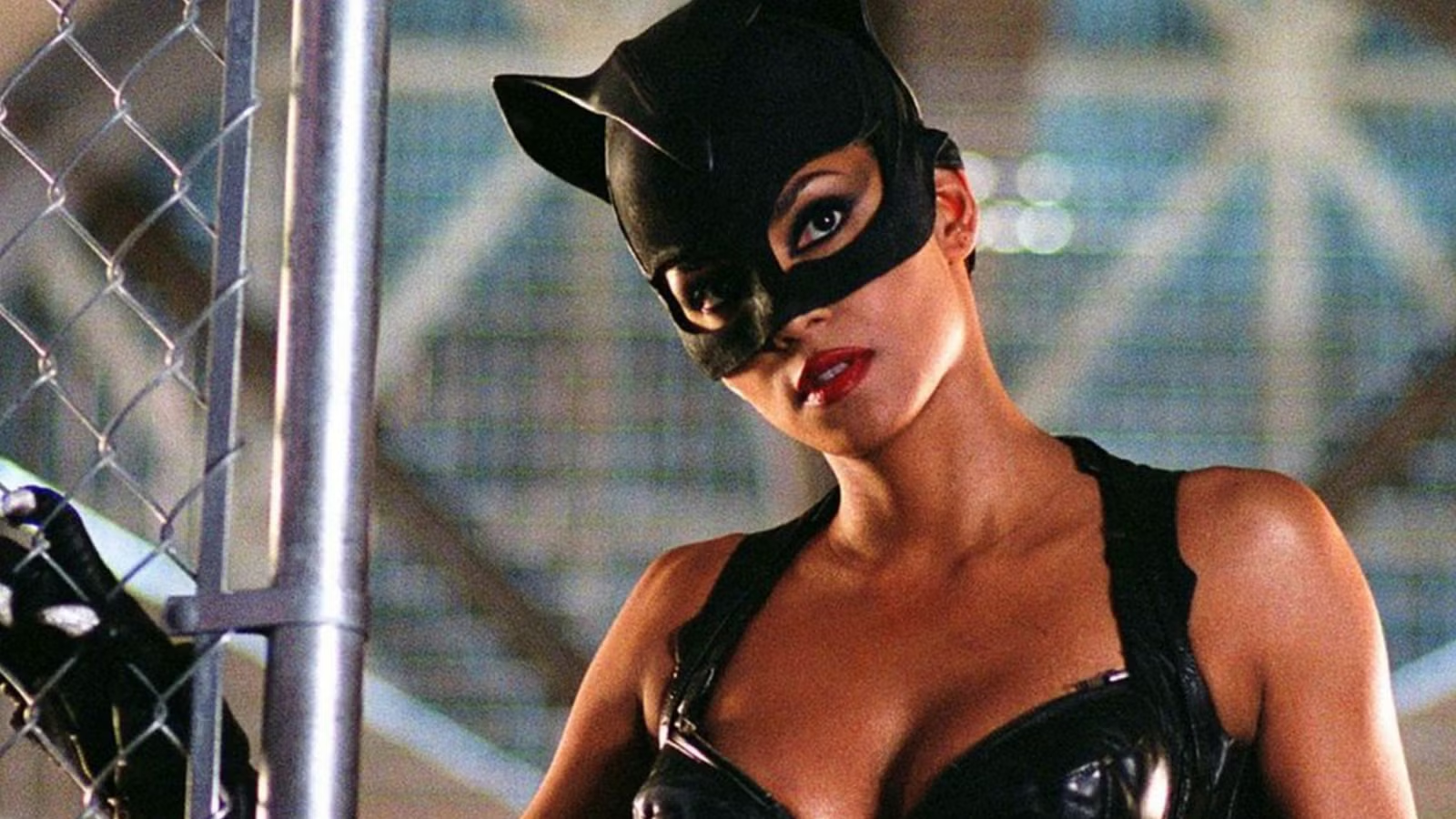
‘Catwoman’ (2004)

Catwoman is bad in ways that almost feel supernatural. Comic-book action cinema has room for camp, room for nonsense, room for horny pulp weirdness, room for stylized trash. In theory, a standalone Catwoman vehicle starring Halle Berry could have become any number of enjoyable things, sleek neo-noir, ridiculous erotic comic-book fun, feline-thief chaos, revenge fantasy with claws. Instead the movie behaves like it was assembled by people who had only heard superhero movies described to them through a wall.
Nothing in it connects. Patience Phillips (Halle Berry) is not written like a person or even like a satisfying fantasy avatar. She is written like a pile of studio guesses about empowerment, sexiness, awkwardness, and edge. Halle Berry commits hard enough that the performance almost becomes its own alien artifact, though the movie around her is so tonally broken that commitment just makes the wreckage sadder. The basketball-flirting sequence has become infamous for a reason. It is one of those scenes where every decision, editing, camera movement, body language, dialogue, all of it feels catastrophically wrong at once. And the action is a similar disaster. Weightless CG, confused cutting, no predatory grace, no coherent build. A character built around agility and danger is turned into visual static. It is astonishing.
2
‘Simon Sez’ (1999)

Bad action movies usually have at least one accidental lifeline. A star you can cling to. One decent fistfight. One chase. One villain weird enough to remember. Simon Sez seems determined to deny the audience even those crumbs. The premise, Simon (Dennis Rodman) as an Interpol-ish operative protecting a scientist’s daughter from terrorists, sounds like a direct-to-video dare. Again, that is not automatically fatal. There are cheap action programmers with sillier setups that still scrape together enough charm, pace, or stunt work to justify their existence. This one feels barely alive from scene to scene.
Now Rodman’s acting wasn’t exactly great, which in itself could have been survivable if the film knew how to turn his eccentricity into comic-book energy. Instead it strands him in limp banter, shapeless scenes, and action staged with absolutely no conviction. Dane Cook shows up and somehow makes things even more irritating, pushing the tone into a kind of bargain-bin smirkiness that kills whatever little threat the film might have generated. The whole movie has that late-90s straight-to-video disease where everything looks vaguely metallic and exhausted before it even starts. And the fights, the chases, the supposed fun, none of it ever rises above the level of obligation. It is not gloriously awful. It is just a void.
1
‘Ballistic: Ecks vs. Sever’ (2002)

There are bad action movies, and then there is Ballistic: Ecks vs. Sever, which feels like a hostile experiment designed to determine how many bullets, explosions, tactical poses, and “serious” faces can be shoved into a movie before all meaning leaves the image completely. Jeremiah Ecks (Antonio Banderas) and Sever (Lucy Liu) as rival super-operatives should not be impossible to work with. That is usable pulp material. Give them clean objectives, let them stalk and counter-stalk each other through good locations, stage fights with clarity, build to a real collision of styles. But no. Instead, the movie turns everything into sludge.
Jeremiah Ecks (Antonio Banderas) and Sever (Lucy Liu) move through scenes like they have been handed fragments of different scripts. The editing is catastrophic. The story is incomprehensible in the deadest way, not intriguingly tangled, just incoherent. Every set piece arrives without shape and leaves without impact. Even the title sounds like something a parody would invent to mock early-2000s action branding, and the movie lives down to it. Worst of all, there is no trashy fun to rescue the experience. No lurid personality. No inspired excess. No one great action beat you can point to and say at least they had that. It is pure action abstraction with none of the genre’s sensual pleasure left inside it. For a fan of action cinema, that is almost the unforgivable sin. It takes a form built on movement and makes it feel inert.

Ballistic: Ecks vs. Sever
- Release Date
-
September 20, 2002
- Runtime
-
91 Minutes
- Director
-
Wych Kaosayananda
- Writers
-
Alan B. McElroy


